
- Getting Started
- Creating Your First Funnel
- CartFlows Funnel Step Types
- Starting a Funnel from a Product Page
- How to Edit and Customise Funnel Steps
- Using CartFlows with or without Store Checkout
- How to Add /Assign Products to a Checkout Step
- How to Create One-Click Upsell and Downsell Offers
- How to Use Canvas Mode to Visualize Your Sales Funnel
- Hiding Fields on the Checkout Page
- Installing WooCommerce
- Using WooCommerce
- Adding Products in WooCommerce
- Using Your Theme's Header & Footer in a Step
- Embedding a Checkout Form on the Checkout Page
- Hiding WooCommerce Pages and Products
- Using Pricing Tables
- Adding an Affiliate Program
- Setting a Funnel as the Homepage
- Dynamic Offers aka Rule Engine
- Instant Layout for Checkout and Thank You Step
- Adding Products from the URL to the Checkout Page
- Deleting Plugin Data During Uninstallation
- Importing Ready-Made Templates for Funnels and Steps
- Importing and Exporting Funnels and Step
- URL Parameters
- Replacing the Main Checkout Order with an Upsell or Downsell
- Rolling back to a Previous Version
- Using the "Order Custom Field" Rule of Dynamic Offers with Custom Field Editor
- Google Address Autocomplete
- Flatsome UX Builder
- ActiveCampaign
- Paypal Reference Transactions
- How PaypPal/Stripe Works
- Enabling Enfold Avia Layout Builder
- Setting Up Authorize.net for Upsell & Downsell
- Supported Payment Gateways
- Setting Quantity and Discount for Products on the Checkout Page
- Adding Custom Payment Gateway Support for One-Click Upsell and Downsell
- Funnel in Test Mode
- Troubleshooting Plugin and Theme Conflicts
- Resolving the "Please Select a Simple, Virtual, and Free Product" Error
- Fixing Endless Loading on the Checkout Page
- Fixing the "We can't seem to find an order for you." Error on the Thank You Page
- Troubleshooting License Activation Issues
- Fixing the "Checkout ID Not Found" Error
- Fixing the "Session Expired" Error Message
- Resolving "Order Does Not Exist" Error on Upsell/Downsell Page
- Fixing the "Sorry, This Product Cannot Be Purchased" Error
- Disabling Auto-fill of Address Fields Based on Zip Code
- Enabling Theme's Scripts & Styles Without Changing Page Template
- Disabling Auto-fill of Checkout Fields
- Allowing Cache Plugins to Cache CartFlows Pages
- Changing the "Choose a Variation" Text
- VAT Field Not Displaying for WooCommerce EU/UK VAT Compliance Plugin
- Enabling the Product Tab on Store Checkout
- Displaying the Order Summary Open on Mobile Devices
- Refreshing the Checkout Page After CartFlows AJAX Calls
- Overview
- Installing Modern Cart Starter
- Installing Modern Cart Pro
- Activating License Key
- Customizing General Settings
- Customizing Cart Tray Labels
- Customizing Cart Icon Settings
- Customizing Cart Tray Styling
- Understanding the Product Recommendations Feature
- Controlling Product Recommendation Source for Empty Cart
- Installing Free Version
- Installing Pro Version
- Activating License Key
- Configuring the Settings
- Enabling Webhooks
- Product Reports
- SMS Integration
- WhatsApp Integration
- Email/Domain Blacklist
- Shortcode Reference for Email Fields
- Filters to Customize Product Table
- Recovery Email Going to Spam
- Cookies/GDPR Compliance
- Emails not Sending
- Orders Not Capturing
- Dynamic Email Rules
- Excluding Products from Coupon
- Rolling Back to a Previous Version
- Setting Up Abandoned Cart Email Sequences
- How Cart Abandonment Tracking Works
- Creating and Customizing Email Templates
- Using Unique Recovery Links / One-Click Cart Recovery
- Adding Coupon Incentives to Recovery Emails
- Setting Up Abandoned Cart Recovery for Guest vs Registered Users
- Analytics & Reporting Overview
- Recovering Unpaid / Failed Orders
- Configuring Abandonment Timeout / Cart Cut-Off Time
- Admin Copy of Recovery Emails (CC/BCC)
- A/B Testing Recovery Emails and Coupons
- Segmenting Abandonment Recovery by Cart Value
- Recovery Email Deliverability Best Practices
- Viewing and Managing the Abandoned Carts
- Unsubscribe / Opt-Out Handling for Recovery Emails
- GDPR / Privacy Compliance
- Testing Cart Abandonment Recovery Emails
- On-Site Reminder Banner
- Pausing or Disabling Cart Abandonment for Specific Products or Categories
Using Unique Recovery Links / One-Click Cart Recovery
The Cart Abandonment Recovery plugin automatically generates a unique recovery link for every abandoned cart. When a customer clicks this link in a recovery email, their cart is instantly restored and they are taken directly to the checkout page — no need to search for items or re-add products.
This guide explains how the recovery link works, how to add it to your email templates, and how to customize the checkout experience customers see when they click through.
How It Works
When a cart is abandoned, the plugin captures the cart session and assigns it a unique token. This token is embedded into a personalized checkout URL. When the customer clicks the link:
- Their original cart items are automatically restored.
- Any coupon code configured in the email template is applied automatically.
- The customer lands directly on the checkout page, ready to complete the purchase.
This is commonly referred to as One-Click Cart Recovery — the customer does not need to take any manual steps to rebuild their cart.
Adding the Recovery Link to Your Email Template
To include the recovery link in a recovery email, use the {{cart.checkout_url}} shortcode in your email template.
To add the link:
1. Go to WooCommerce > Cart Abandonment > Follow Up Templates.
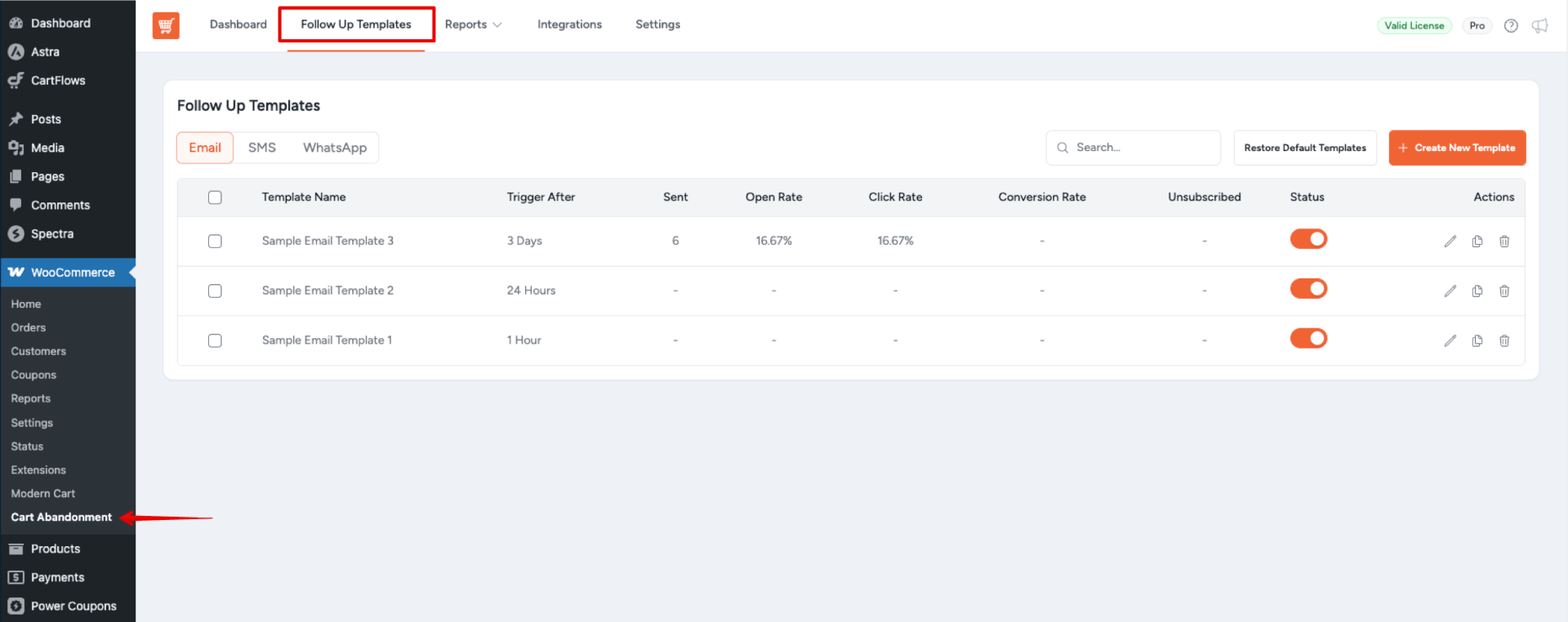
2. Open an existing template or create a new one.
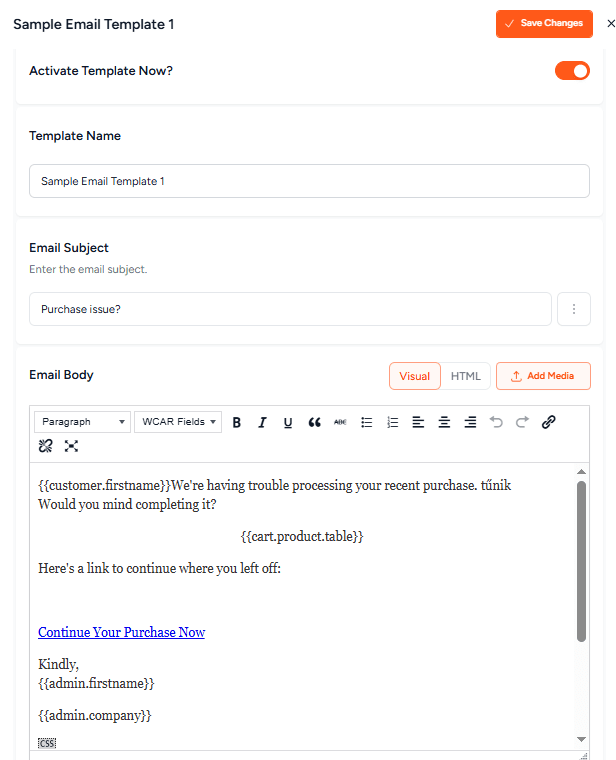
3. In the email body, insert the shortcode {{cart.checkout_url}} wherever you want the recovery link to appear.
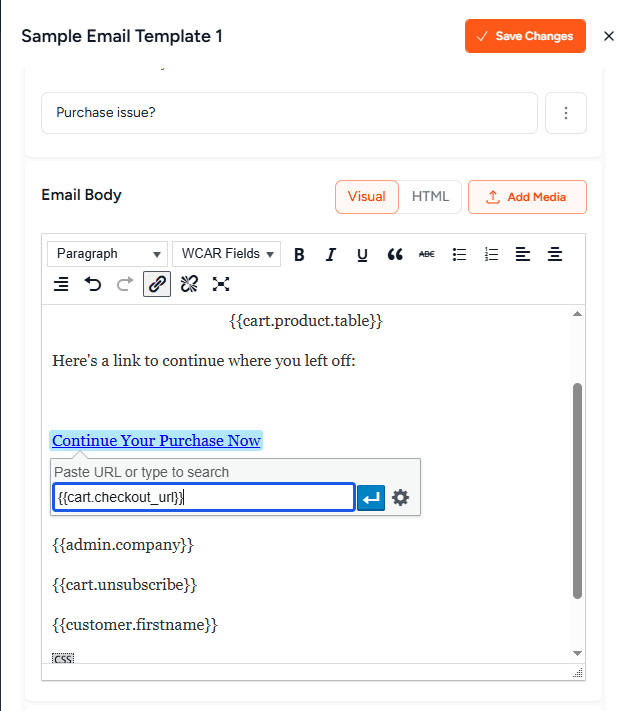
4. Save your template.
Note
The {{cart.checkout_url}} shortcode generates a complete, unique URL for each customer. You can use it as a plain text link or wrap it in a button using your email editor’s link/button tools.
Using the Shortcode as a Button
For higher click-through rates, it is recommended to display the recovery link as a button. The email editor allows you to apply button styling to a link using HTML editor. Simply use {{cart.checkout_url}} as the URL target of a button element.
<a href="{{cart.checkout_url}}" style="display:inline-block;background-color:#2271b1;color:#ffffff;padding:12px 24px;text-decoration:none;border-radius:4px;font-weight:bold;">Complete Your Purchase</a>
Example display text for the button:
- Complete Your Purchase
- Return to Your Cart
- Claim Your Discount
Combining the Recovery Link with a Coupon
You can pair the {{cart.checkout_url}} shortcode with the {{cart.coupon_code}} shortcode to display a discount offer alongside the recovery link. When the customer clicks the checkout URL, the coupon is applied automatically — they do not need to enter the code manually.
Example email copy:
| Hi {{customer.firstname}},You left something behind! Use code {{cart.coupon_code}} to get a discount — it’s applied automatically when you click the link below.{{cart.checkout_url}} |
Note
To generate a coupon automatically in recovery emails, you must configure a coupon in the email template settings. See the Configuring Cart Abandonment Recovery Settings documentation for more details.
Available Shortcodes for Recovery Emails
The following shortcodes can be used in any recovery email template to personalize the message and include the recovery link.
| Shortcode | Description |
{{cart.checkout_url}} | The unique recovery link that restores the customer’s cart and redirects them to checkout. |
{{cart.coupon_code}} | The coupon code automatically applied when the customer clicks the recovery link. |
{{customer.firstname}} | The customer’s first name. |
{{customer.lastname}} | The customer’s last name. |
{{customer.fullname}} | The customer’s full name. |
{{cart.product.table}} | A table showing abandoned products with name, image, quantity, price, and line subtotal. |
{{cart.product.names}} | A plain-text list of the abandoned product names. |
{{cart.abandoned_date}} | The date on which the cart was abandoned. |
{{cart.unsubscribe}} | An unsubscribe link allowing customers to opt out of future recovery emails. |
{{admin.firstname}} | The shop owner’s or administrator’s name. |
{{admin.company}} | The shop or company name. |
{{site.url}} | The main URL of the store. |
What Customers See When They Click the Link
When a customer clicks the {{cart.checkout_url}} link in a recovery email:
- They are taken directly to the WooCommerce checkout page.
- Their previously abandoned cart items are pre-loaded.
- If a coupon was configured, it is automatically applied to the order.
- All checkout fields are pre-filled if the customer had previously entered their details.
The customer can then complete the purchase in a single step — no cart rebuilding required.
Link Expiry and Security
Each recovery link contains a unique session token tied to the specific abandoned cart. This means:
- Each link is unique to one customer and one cart session.
- A link cannot be reused across different customers.
- Once the cart is recovered (i.e., the order is completed), no further recovery emails are sent for that session.
Note
If a customer clicks the recovery link but does not complete checkout, the cart remains in the abandoned state and future scheduled emails (if configured) will continue to be sent.
We don't respond to the article feedback, we use it to improve our support content.