
- Hiding Fields on the Checkout Page
- Installing WooCommerce
- Using WooCommerce
- Adding Products in WooCommerce
- Using Your Theme's Header & Footer in a Step
- Embedding a Checkout Form on the Checkout Page
- Hiding WooCommerce Pages and Products
- Using Pricing Tables
- Adding an Affiliate Program
- Setting a Funnel as the Homepage
- Dynamic Offers aka Rule Engine
- Instant Layout for Checkout and Thank You Step
- Adding Products from the URL to the Checkout Page
- Deleting Plugin Data During Uninstallation
- Importing Ready-Made Templates for Funnels and Steps
- Importing and Exporting Funnels and Step
- URL Parameters
- Replacing the Main Checkout Order with an Upsell or Downsell
- Rolling back to a Previous Version
- Using the "Order Custom Field" Rule of Dynamic Offers with Custom Field Editor
- Optin
- Separate Orders
- Setting Up Pre-Checkout Upsell
- Refund Offer
- Applying a Coupon from the URL
- How to Create a Direct Buy-Now Checkout Link for a Product
- How Coupons Work in CartFlows?
- User role manager
- Instant Layout for Upsell and Downsell
- CartFlows Smart Login
- How to Set Preferred Countries on the Checkout Page
- CartFlows Product Options
- How to Set Up Two Step Checkout in CartFlows
- How to Set Up Multistep Checkout in CartFlows
- How to Customize the CartFlows Thank You Page
- Google Address Autocomplete
- Flatsome UX Builder
- ActiveCampaign
- Paypal Reference Transactions
- How PaypPal/Stripe Works
- Enabling Enfold Avia Layout Builder
- Setting Up Authorize.net for Upsell & Downsell
- Supported Payment Gateways
- Setting Quantity and Discount for Products on the Checkout Page
- Adding Custom Payment Gateway Support for One-Click Upsell and Downsell
- Funnel in Test Mode
- Troubleshooting Plugin and Theme Conflicts
- Resolving the "Please Select a Simple, Virtual, and Free Product" Error
- Fixing Endless Loading on the Checkout Page
- Fixing the "We can't seem to find an order for you." Error on the Thank You Page
- Troubleshooting License Activation Issues
- Fixing the "Checkout ID Not Found" Error
- Fixing the "Session Expired" Error Message
- Resolving "Order Does Not Exist" Error on Upsell/Downsell Page
- Fixing the "Sorry, This Product Cannot Be Purchased" Error
- Disabling Auto-fill of Address Fields Based on Zip Code
- Enabling Theme's Scripts & Styles Without Changing Page Template
- Disabling Auto-fill of Checkout Fields
- Allowing Cache Plugins to Cache CartFlows Pages
- Changing the "Choose a Variation" Text
- VAT Field Not Displaying for WooCommerce EU/UK VAT Compliance Plugin
- Enabling the Product Tab on Store Checkout
- Displaying the Order Summary Open on Mobile Devices
- Refreshing the Checkout Page After CartFlows AJAX Calls
- Overview
- Installing Modern Cart Starter
- Installing Modern Cart Pro
- Activating License Key
- Customizing General Settings
- Customizing Cart Tray Labels
- Customizing Cart Icon Settings
- Customizing Cart Tray Styling
- Understanding the Product Recommendations Feature
- Controlling Product Recommendation Source for Empty Cart
How to Export, Import, and Back Up Your CartFlows Funnels
CartFlows lets you export your funnels to a file and import them on any WordPress site. It’s an easy way to keep a backup of your funnels, move them to a new site, or reuse a funnel you’ve already built.
This guide covers the different ways to export funnels, how to back them up, and how to import them again.
How Funnel Export Works
When you export, CartFlows saves your funnel into a small .json file that downloads to your computer.
- The file holds the funnel, all of its steps, their settings, and the page design of each step.
- You can export one funnel, a few selected funnels, or every funnel at once.
- Importing the file on any site recreates the funnels as new funnels, ready to edit.
Your existing funnels are never changed by exporting, so you can export as often as you like.
Export a Single Funnel
You can export a single funnel from the Funnels list or from inside the funnel.
Step 1. From the WordPress admin, go to CartFlows → Funnels.
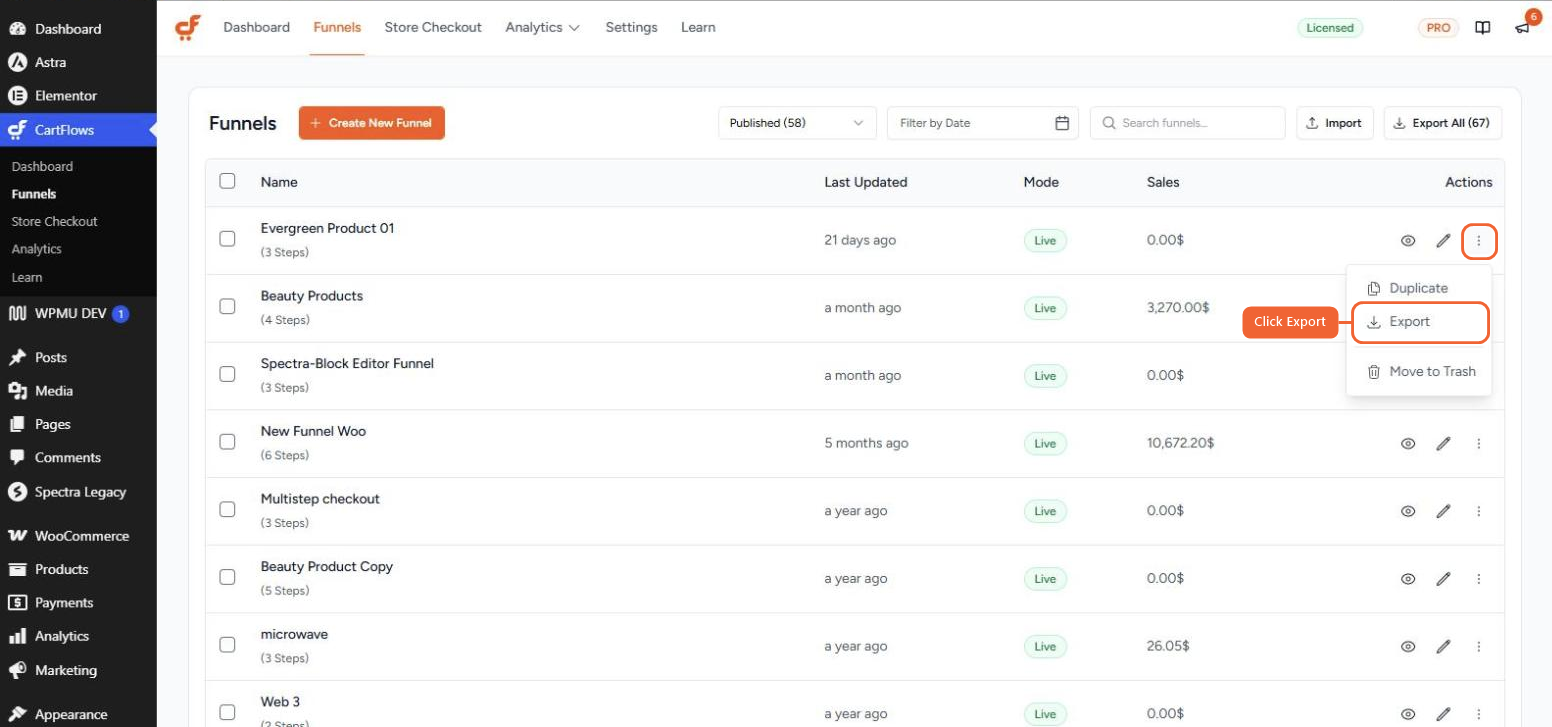
Step 2. Click the three dots next to the funnel you want to export, then click Export.
You can also export a funnel while you’re editing it. Open the funnel and click the Export icon at the top right, next to the settings icon.
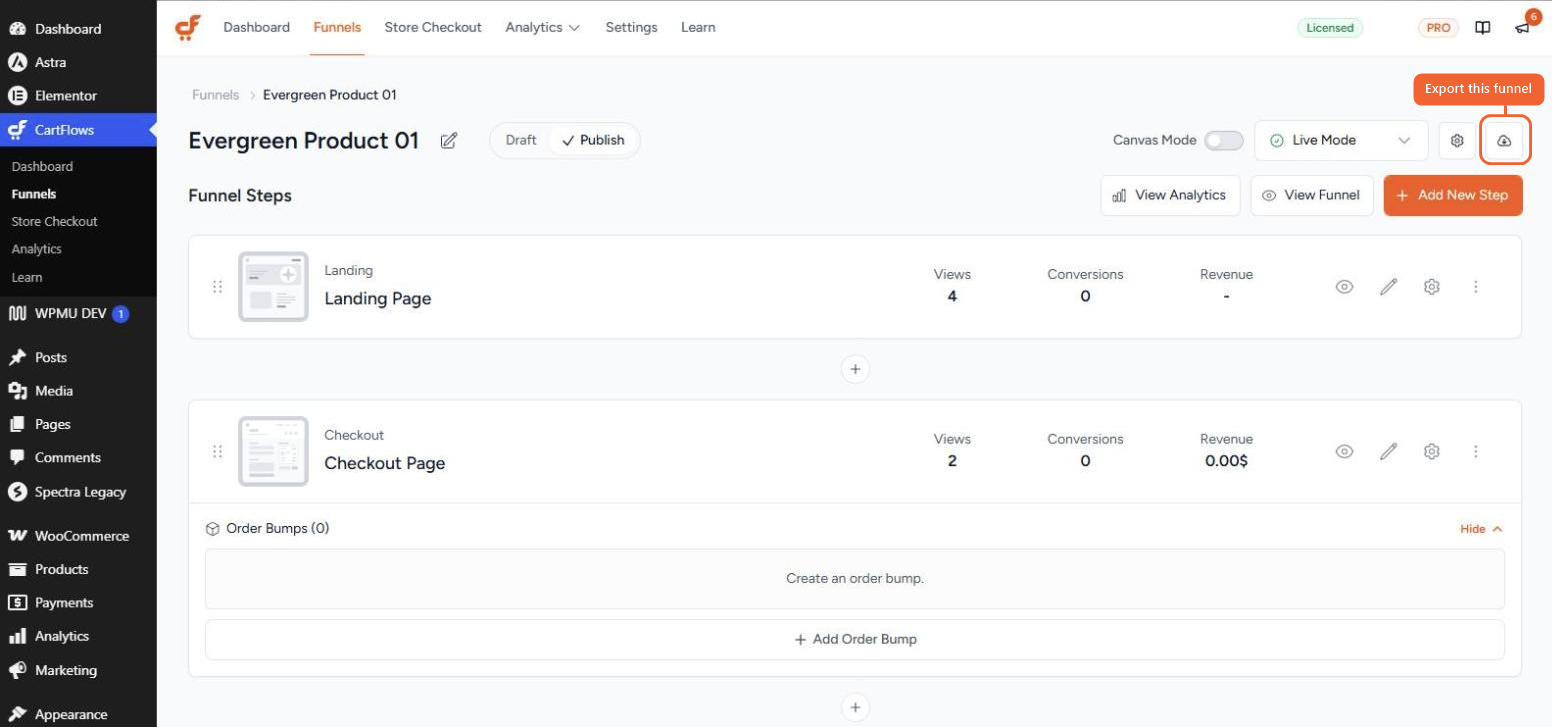
The file downloads right away and is named after the funnel.
Export Several Funnels at Once
Step 1. Go to CartFlows → Funnels.
Step 2. Tick the checkbox next to each funnel you want to export.
Step 3. Click Export in the bar that appears above the list.
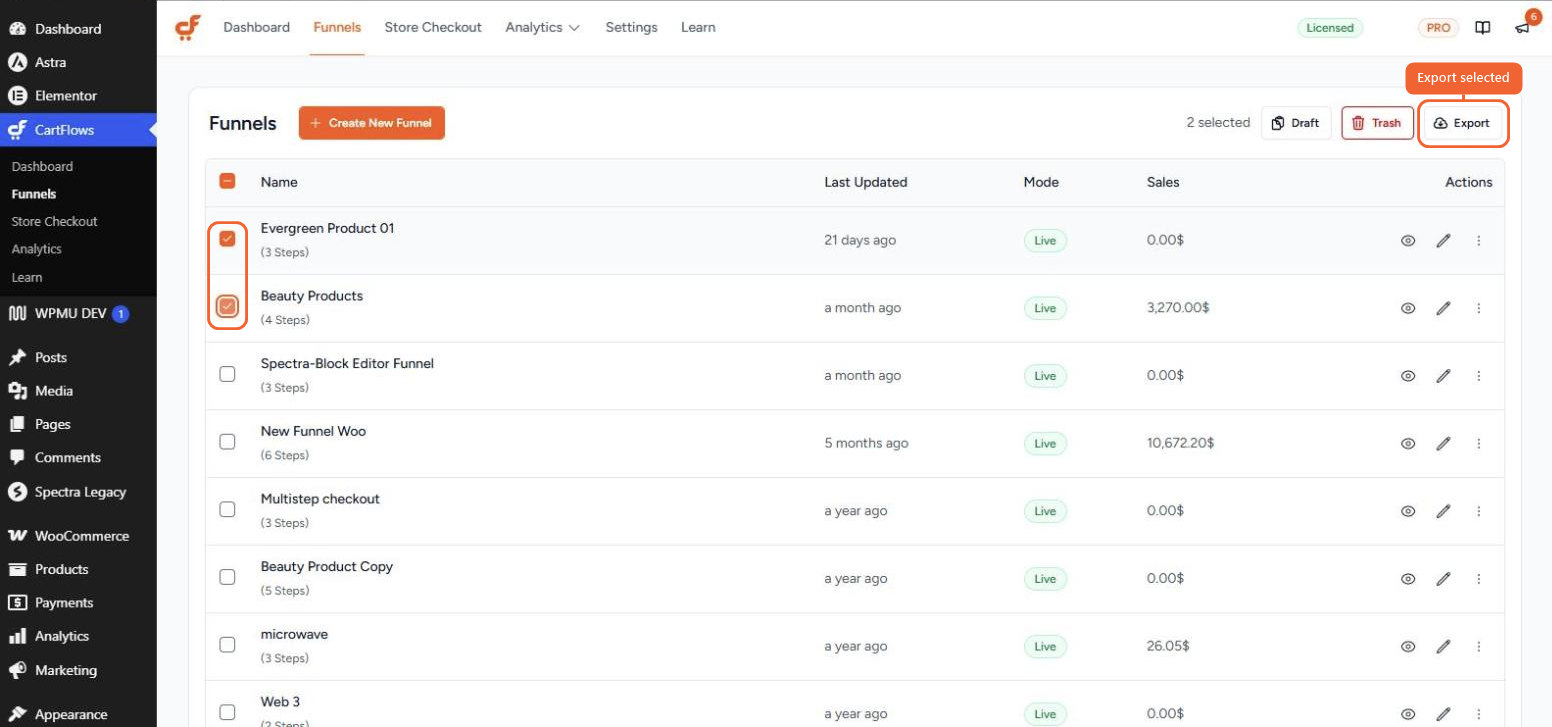
All the selected funnels are saved together in one file.
Export All Funnels
To export every funnel on your site in one go, click Export All at the top right of the CartFlows → Funnels page. The number next to the button shows how many funnels will be included.
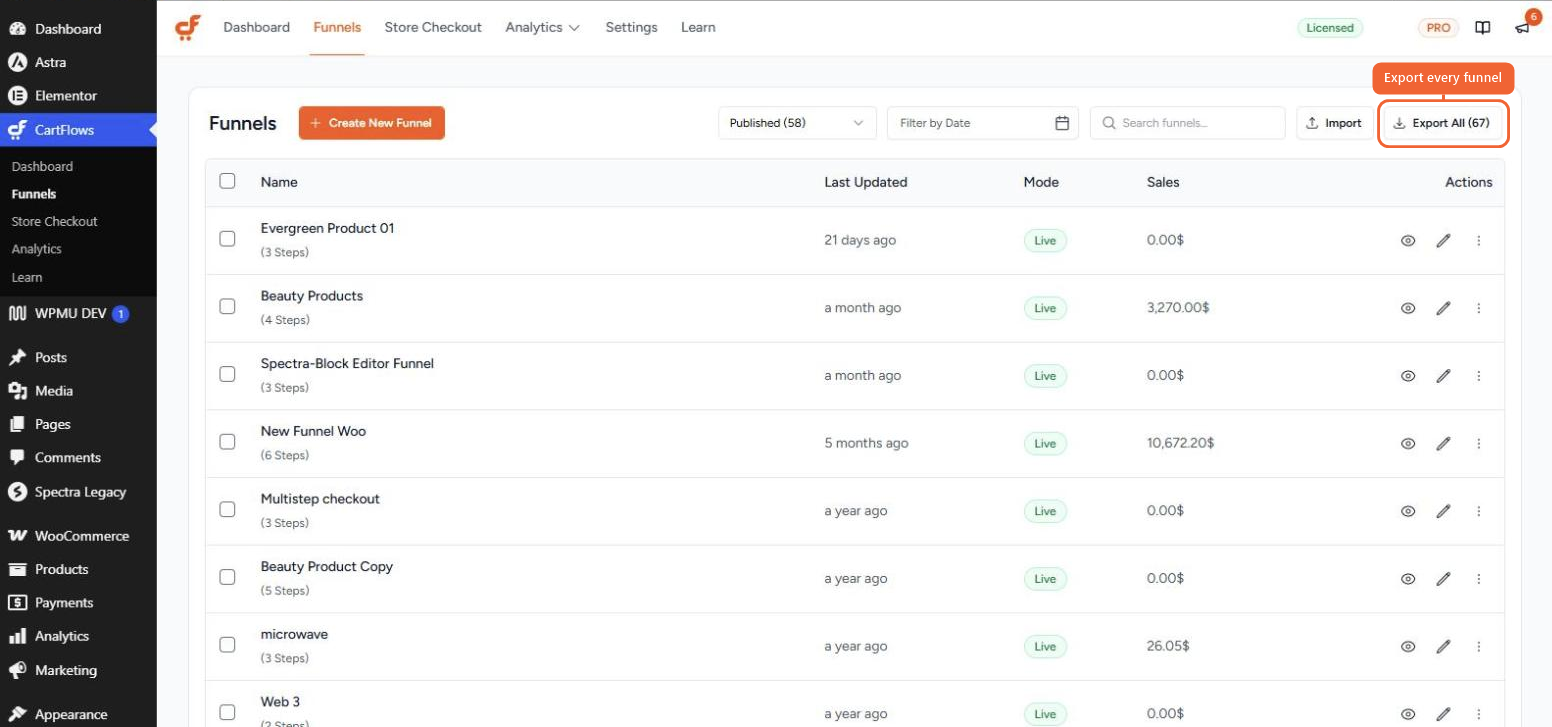
CartFlows saves all your funnels into a single file named with the date, such as cartflows-flows-export-6-10-2026.json.
Back Up Your Funnels
Export All is the quickest way to keep a backup of your funnels. A good habit is to export a fresh copy:
- Before updating CartFlows, your theme, or your page builder.
- Before making big changes to a funnel that is already making sales.
- Before moving your store to a new host or domain.
Keep the downloaded file somewhere safe, such as a cloud drive. The dated file name makes it easy to find the right version later.
Import a Funnel
Step 1. Go to CartFlows → Funnels and click Import at the top right.
Step 2. Drag your .json file into the upload area, or click Upload a file to choose it. Files can be up to 5MB.
Step 3. Click Import Funnel.
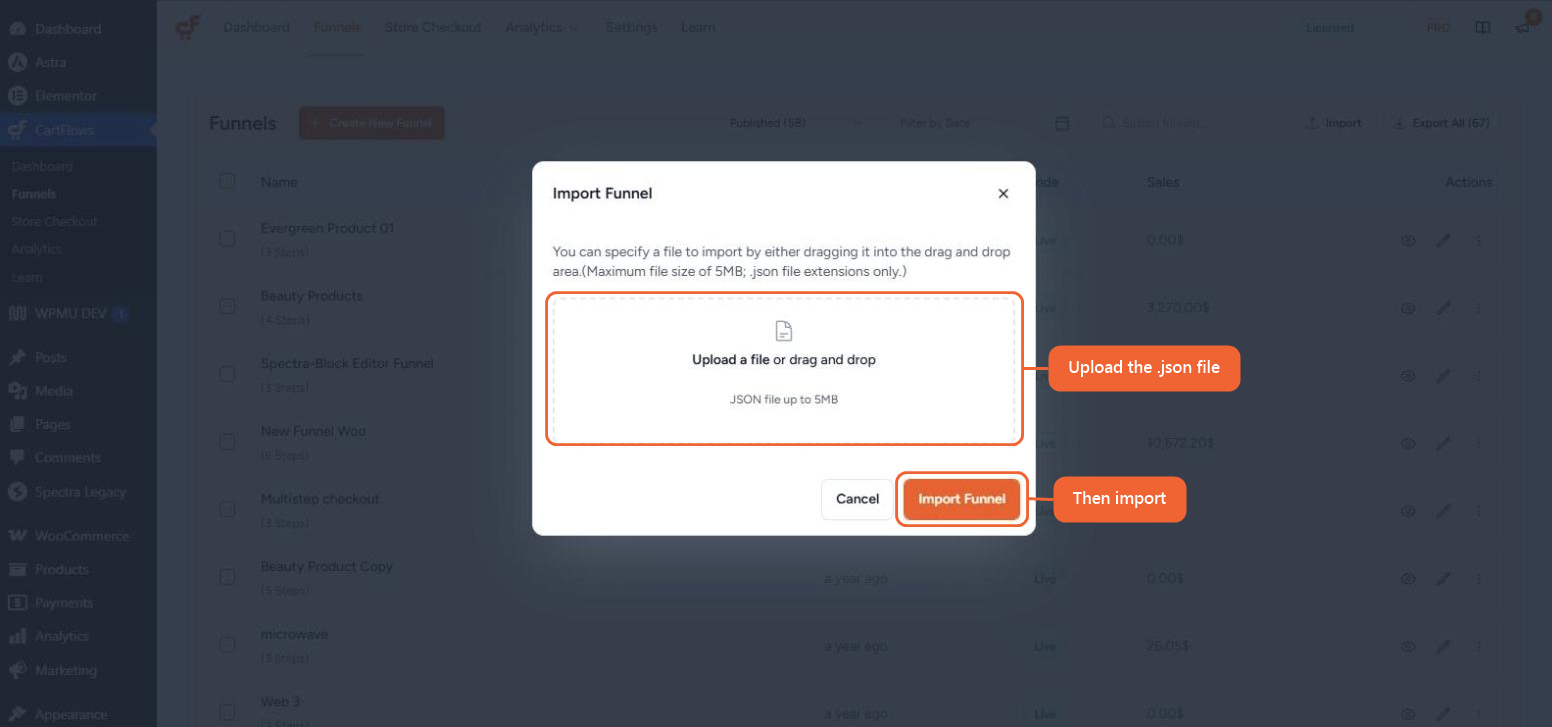
The imported funnels appear in your Funnels list and are published right away. If the file holds several funnels, they are all imported together.
After Importing on a New Site
Products and checkout settings are tied to each store, so a few quick checks will get an imported funnel ready to sell:
- Open each Checkout and Opt-in step and assign your products.
- Re-select the products in any Order Bumps, Upsells, and Downsells.
- Preview each step to make sure the design and images look right.
Tip: For the smoothest import, export from a live or staging site. During import, CartFlows copies each step’s images from the original site, so that site needs to be reachable online.
Import or Export a Single Step Design
If you want to move the design of an individual funnel step, you can do so using your page builder’s template import or export options.
- Go to the funnel step you want to modify.
- Click the edit (pencil) icon on the step to open it in your page builder.
- Use the builder’s import/export tool to upload or download the template.
Each page builder handles templates differently. Use the following guides to learn more:
Frequently Asked Questions
We don't respond to the article feedback, we use it to improve our support content.