
- Hiding Fields on the Checkout Page
- Installing WooCommerce
- Using WooCommerce
- Adding Products in WooCommerce
- Using Your Theme's Header & Footer in a Step
- Embedding a Checkout Form on the Checkout Page
- Hiding WooCommerce Pages and Products
- Using Pricing Tables
- Adding an Affiliate Program
- Setting a Funnel as the Homepage
- Dynamic Offers aka Rule Engine
- Instant Layout for Checkout and Thank You Step
- Adding Products from the URL to the Checkout Page
- Deleting Plugin Data During Uninstallation
- Importing Ready-Made Templates for Funnels and Steps
- Importing and Exporting Funnels and Step
- URL Parameters
- Replacing the Main Checkout Order with an Upsell or Downsell
- Rolling back to a Previous Version
- Using the "Order Custom Field" Rule of Dynamic Offers with Custom Field Editor
- Google Address Autocomplete
- Flatsome UX Builder
- ActiveCampaign
- Paypal Reference Transactions
- How PaypPal/Stripe Works
- Enabling Enfold Avia Layout Builder
- Setting Up Authorize.net for Upsell & Downsell
- Supported Payment Gateways
- Setting Quantity and Discount for Products on the Checkout Page
- Adding Custom Payment Gateway Support for One-Click Upsell and Downsell
- Funnel in Test Mode
- Troubleshooting Plugin and Theme Conflicts
- Resolving the "Please Select a Simple, Virtual, and Free Product" Error
- Fixing Endless Loading on the Checkout Page
- Fixing the "We can't seem to find an order for you." Error on the Thank You Page
- Troubleshooting License Activation Issues
- Fixing the "Checkout ID Not Found" Error
- Fixing the "Session Expired" Error Message
- Resolving "Order Does Not Exist" Error on Upsell/Downsell Page
- Fixing the "Sorry, This Product Cannot Be Purchased" Error
- Disabling Auto-fill of Address Fields Based on Zip Code
- Enabling Theme's Scripts & Styles Without Changing Page Template
- Disabling Auto-fill of Checkout Fields
- Allowing Cache Plugins to Cache CartFlows Pages
- Changing the "Choose a Variation" Text
- VAT Field Not Displaying for WooCommerce EU/UK VAT Compliance Plugin
- Enabling the Product Tab on Store Checkout
- Displaying the Order Summary Open on Mobile Devices
- Refreshing the Checkout Page After CartFlows AJAX Calls
- Overview
- Installing Modern Cart Starter
- Installing Modern Cart Pro
- Activating License Key
- Customizing General Settings
- Customizing Cart Tray Labels
- Customizing Cart Icon Settings
- Customizing Cart Tray Styling
- Understanding the Product Recommendations Feature
- Controlling Product Recommendation Source for Empty Cart
- Installing Free Version
- Installing Pro Version
- Activating License Key
- Configuring the Settings
- Enabling Webhooks
- Product Reports
- SMS Integration
- WhatsApp Integration
- Email/Domain Blacklist
- Shortcode Reference for Email Fields
- Filters to Customize Product Table
- Recovery Email Going to Spam
- Cookies/GDPR Compliance
- Emails not Sending
- Orders Not Capturing
- Dynamic Email Rules
- Excluding Products from Coupon
- Rolling Back to a Previous Version
- Setting Up Abandoned Cart Email Sequences
- How Cart Abandonment Tracking Works
- Creating and Customizing Email Templates
- Using Unique Recovery Links / One-Click Cart Recovery
- Adding Coupon Incentives to Recovery Emails
- Setting Up Abandoned Cart Recovery for Guest vs Registered Users
- Analytics & Reporting Overview
- Recovering Unpaid / Failed Orders
- Configuring Abandonment Timeout / Cart Cut-Off Time
- Admin Copy of Recovery Emails (CC/BCC)
- A/B Testing Recovery Emails and Coupons
- Segmenting Abandonment Recovery by Cart Value
- Recovery Email Deliverability Best Practices
- Viewing and Managing the Abandoned Carts
- Unsubscribe / Opt-Out Handling for Recovery Emails
- GDPR / Privacy Compliance
- Testing Cart Abandonment Recovery Emails
- On-Site Reminder Banner
- Pausing or Disabling Cart Abandonment for Specific Products or Categories
How to Pause or Disable Cart Abandonment for Specific Products or Categories
Sometimes you don’t want every abandoned cart to trigger a recovery email. Common cases:
- Subscription — the customer didn’t abandon, they’re mid-flow; a recovery email is confusing.
- Sensitive products — adult products, health products, or legal-gray items where a follow-up email is inappropriate.
- Free trials or $0 orders — no recovery needed; the cart total doesn’t warrant outreach.
- Wholesale / B2B orders — these customers prefer phone follow-up, not automated emails.
- Specific SKUs you don’t want to discount — exclude them so they don’t receive coupon codes.
Cart Abandonment Recovery doesn’t have a dedicated “exclude product” toggle, but with the Pro Rule Engine you can achieve the same result by scoping every recovery template to exclude the products or categories you don’t want.
This guide shows two approaches:
- Pro approach — Rule Engine with “does not contain” conditions
- Free approach — global tracking toggle + careful workarounds
Most flexibility requires Pro. The free version only supports globally enabling or disabling tracking — there’s no per-product or per-category exclusion. If product-level control is critical, Pro’s Rule Engine is the tool.
Prerequisites
- Cart Abandonment Recovery installed and activated (Pro recommended)
- WooCommerce categories or tags set up on the products you want to include/exclude
- At least one email template created
Method 1 — Pro Rule Engine: Exclude Specific Products or Categories
How It Works
Open each recovery template and add a condition that says: “only fire if the cart does NOT contain these products / categories.” The plugin evaluates every cart against these rules, and carts containing the excluded items get no recovery message.
For a complete guide on setting up email rules, see the documentation on Dynamic Email Rules.
Step-by-Step
Step 1 — Open Your Recovery Template
Go to WooCommerce > Cart Abandonment > Follow Up Templates and click the ️Edit icon on the template you want to scope.
Step 2 — Enable Dynamic Conditions
Inside the template editor, toggle Enable Dynamic Conditions to ON.
Step 3 — Add a “Does Not Contain” Condition
Click Add Condition and configure:
To exclude a specific product:
| Field | Value |
| Condition | Product |
| Operator | Does not contain |
| Value | Select the product(s) you want to exclude |
To exclude a product category:
| Field | Value |
| Condition | Product Category |
| Operator | Does not contain |
| Value | Select the category(ies) you want to exclude |
Step 4 — Combine Multiple Exclusions (Optional)
You can stack multiple “does not contain” conditions joined by AND:
Product Category → does not contain → Subscriptions
AND
Product Category → does not contain → Adult Products
AND
Product → does not contain → Free Trial Access
This template now only fires for carts that include none of the excluded items.
Step 5 — Apply to All Recovery Templates
If you have multiple recovery templates (e.g., 1-hour nudge, 24-hour reminder, 3-day final), add the same exclusion rules to every template. Otherwise, the excluded products might still receive later emails in the sequence.
Step 6 — Test
Abandon a cart containing only the excluded product — confirm no recovery email arrives. Then abandon a cart with a normal product — confirm recovery works as usual.
Method 2 — Exclude by Cart Total (All Versions With Pro)
If you want to skip recovery for $0 carts (trials, free downloads, test products):
Condition: Cart Total → Greater than → 0
Or to skip small carts not worth chasing:
Condition: Cart Total → Greater than or equal to → 25
Method 3 — Free Version Workarounds
The free version has no per-product or per-category control. Your options are limited but not zero:
Option A — Global Tracking Toggle
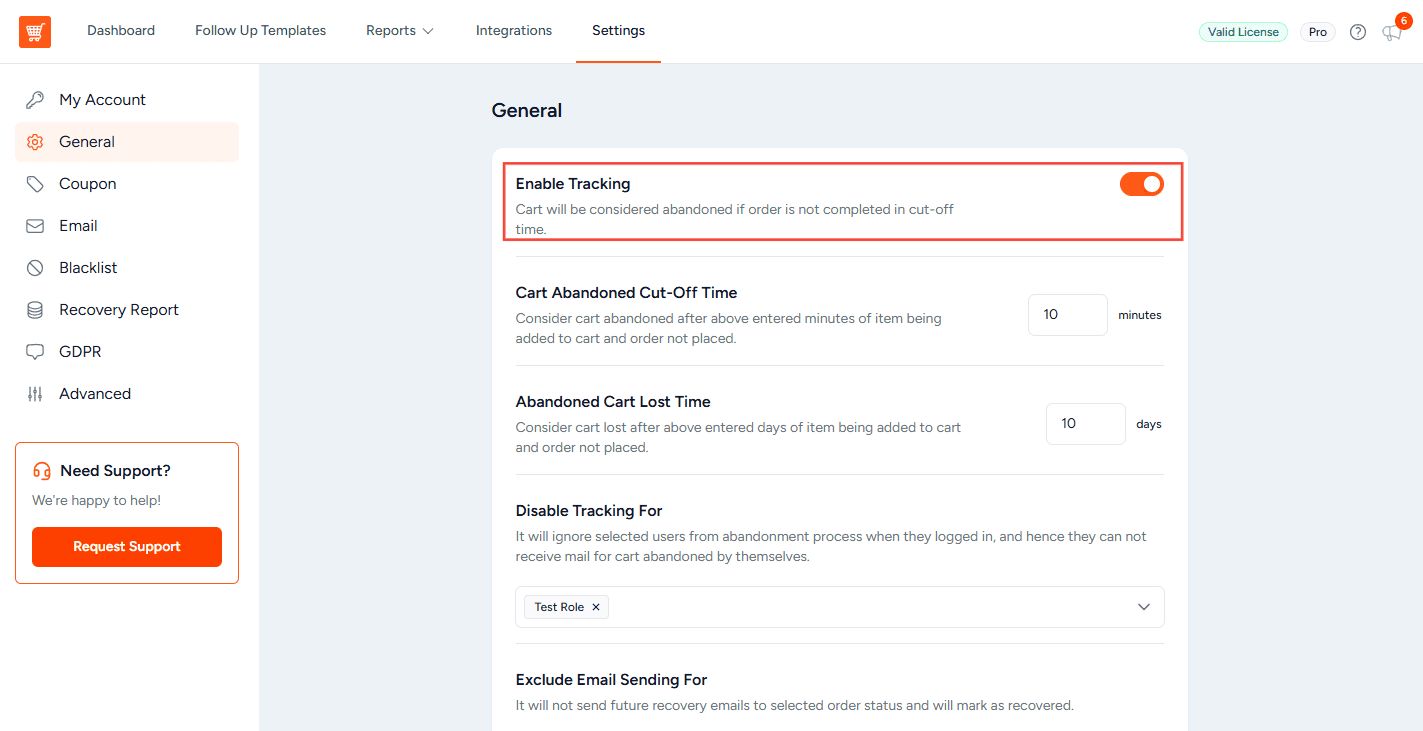
Go to WooCommerce > Cart Abandonment > Settings > General and use the Enable Tracking toggle to completely turn recovery on or off store-wide. This is all-or-nothing.
Option B — Conditional Template Content (Manual)
Write email copy that’s generic enough to work for any product. This doesn’t stop the email, but it avoids awkward product-specific messaging.
Option C — Upgrade to Pro
For full control, Pro is the cleanest solution.
Common Use Cases & Configurations
Use Case 1 — Skip Recovery for Subscription
Condition on every template:
- Product Category → does not contain → Subscriptions
Use Case 2 — Skip $0 Carts / Free Trials
Condition on every template:
- Cart Total → Greater than → 0
Use Case 3 — Exclude a Single High-Value Product From Discount Emails
Create two templates:
- Template A (Discount Offer):
o Product → does not contain → Premium Consulting Package
o Includes a 10% coupon
- Template B (Personal Note):
o Product → contains → Premium Consulting Package
o No coupon, asks customer to reply or book a call
Use Case 4 — Skip Adult / Sensitive Products
Condition on every template:
- Product Category → does not contain → Adult AND → does not contain → 18+
Tips & Best Practices
- Apply rules to every template in your sequence — missing one template means the excluded products still get emails later in the flow.
- Use categories, not individual products, when possible — easier to maintain as your catalog grows.
- Test every exclusion — abandon a cart with the excluded item and confirm no email is sent.
- Document your exclusions — a short note in your internal wiki keeps future admins from wondering why certain carts don’t trigger emails.
- Mind mixed carts — a cart with BOTH an excluded item AND a normal item will be excluded if your condition is “does not contain”. Decide whether that’s the behavior you want.
Troubleshooting
Excluded Products Are Still Getting Emails
- Confirm every recovery template has the exclusion rule (not just one).
- Check that Dynamic Conditions is toggled ON on each template.
- Test with a cart containing only the excluded item.
Carts With Mixed Items Aren’t Being Handled as Expected
- “Does not contain” excludes the cart if any matching item is present. If you want “only exclude carts that are entirely excluded items”, that’s not directly supported — consider two-template logic with opposite conditions instead.
No Emails Sending at All After Adding Rules
- Check that your conditions aren’t too restrictive.
- Verify at least one template’s conditions match realistic cart scenarios.
- Consider a catch-all template with no conditions as a fallback.
FAQs
We don't respond to the article feedback, we use it to improve our support content.