
- Getting Started
- Creating Your First Funnel
- CartFlows Funnel Step Types
- Starting a Funnel from a Product Page
- How to Edit and Customise Funnel Steps
- Using CartFlows with or without Store Checkout
- How to Add /Assign Products to a Checkout Step
- How to Create One-Click Upsell and Downsell Offers
- How to Use Canvas Mode to Visualize Your Sales Funnel
- Hiding Fields on the Checkout Page
- Installing WooCommerce
- Using WooCommerce
- Adding Products in WooCommerce
- Using Your Theme's Header & Footer in a Step
- Embedding a Checkout Form on the Checkout Page
- Hiding WooCommerce Pages and Products
- Using Pricing Tables
- Adding an Affiliate Program
- Setting a Funnel as the Homepage
- Dynamic Offers aka Rule Engine
- Instant Layout for Checkout and Thank You Step
- Adding Products from the URL to the Checkout Page
- Deleting Plugin Data During Uninstallation
- Importing Ready-Made Templates for Funnels and Steps
- Importing and Exporting Funnels and Step
- URL Parameters
- Replacing the Main Checkout Order with an Upsell or Downsell
- Rolling back to a Previous Version
- Using the "Order Custom Field" Rule of Dynamic Offers with Custom Field Editor
- Google Address Autocomplete
- Flatsome UX Builder
- ActiveCampaign
- Paypal Reference Transactions
- How PaypPal/Stripe Works
- Enabling Enfold Avia Layout Builder
- Setting Up Authorize.net for Upsell & Downsell
- Supported Payment Gateways
- Setting Quantity and Discount for Products on the Checkout Page
- Adding Custom Payment Gateway Support for One-Click Upsell and Downsell
- Funnel in Test Mode
- Troubleshooting Plugin and Theme Conflicts
- Resolving the "Please Select a Simple, Virtual, and Free Product" Error
- Fixing Endless Loading on the Checkout Page
- Fixing the "We can't seem to find an order for you." Error on the Thank You Page
- Troubleshooting License Activation Issues
- Fixing the "Checkout ID Not Found" Error
- Fixing the "Session Expired" Error Message
- Resolving "Order Does Not Exist" Error on Upsell/Downsell Page
- Fixing the "Sorry, This Product Cannot Be Purchased" Error
- Disabling Auto-fill of Address Fields Based on Zip Code
- Enabling Theme's Scripts & Styles Without Changing Page Template
- Disabling Auto-fill of Checkout Fields
- Allowing Cache Plugins to Cache CartFlows Pages
- Changing the "Choose a Variation" Text
- VAT Field Not Displaying for WooCommerce EU/UK VAT Compliance Plugin
- Enabling the Product Tab on Store Checkout
- Displaying the Order Summary Open on Mobile Devices
- Refreshing the Checkout Page After CartFlows AJAX Calls
- Overview
- Installing Modern Cart Starter
- Installing Modern Cart Pro
- Activating License Key
- Customizing General Settings
- Customizing Cart Tray Labels
- Customizing Cart Icon Settings
- Customizing Cart Tray Styling
- Understanding the Product Recommendations Feature
- Controlling Product Recommendation Source for Empty Cart
- Installing Free Version
- Installing Pro Version
- Activating License Key
- Configuring the Settings
- Enabling Webhooks
- Product Reports
- SMS Integration
- WhatsApp Integration
- Email/Domain Blacklist
- Shortcode Reference for Email Fields
- Filters to Customize Product Table
- Recovery Email Going to Spam
- Cookies/GDPR Compliance
- Emails not Sending
- Orders Not Capturing
- Dynamic Email Rules
- Excluding Products from Coupon
- Rolling Back to a Previous Version
- Setting Up Abandoned Cart Email Sequences
- How Cart Abandonment Tracking Works
- Creating and Customizing Email Templates
- Using Unique Recovery Links / One-Click Cart Recovery
- Adding Coupon Incentives to Recovery Emails
- Setting Up Abandoned Cart Recovery for Guest vs Registered Users
- Analytics & Reporting Overview
- Recovering Unpaid / Failed Orders
- Configuring Abandonment Timeout / Cart Cut-Off Time
- Admin Copy of Recovery Emails (CC/BCC)
- A/B Testing Recovery Emails and Coupons
- Segmenting Abandonment Recovery by Cart Value
- Recovery Email Deliverability Best Practices
- Viewing and Managing the Abandoned Carts
- Unsubscribe / Opt-Out Handling for Recovery Emails
- GDPR / Privacy Compliance
- Testing Cart Abandonment Recovery Emails
- On-Site Reminder Banner
- Pausing or Disabling Cart Abandonment for Specific Products or Categories
Cart Abandonment Analytics & Reporting Overview
Introduction
The Cart Abandonment Recovery plugin comes with a built-in analytics dashboard and reporting area that give you a clear picture of how many carts are being abandoned, how many you’re recovering, and how much revenue your recovery campaigns are generating.
This guide walks you through every metric, filter, and table available — so you can make data-driven decisions to improve your recovery rate.
Prerequisites
- Cart tracking enabled under Settings > General > Enable Tracking
- At least a few recorded abandoned and/or recovered carts (reports will appear empty otherwise)
Overview: Two Places to Find Analytics
| Location | What You’ll Find |
| Dashboard tab | High-level summary: 6 stat cards + two-series revenue chart |
| Reports > Follow Up tab | Full abandoned carts list with email-level detail and export |
| Reports > Product tab | Product-level abandonment stats (Pro) |
The Dashboard Tab
Go to WooCommerce > Cart Abandonment — the Dashboard is the default landing tab.
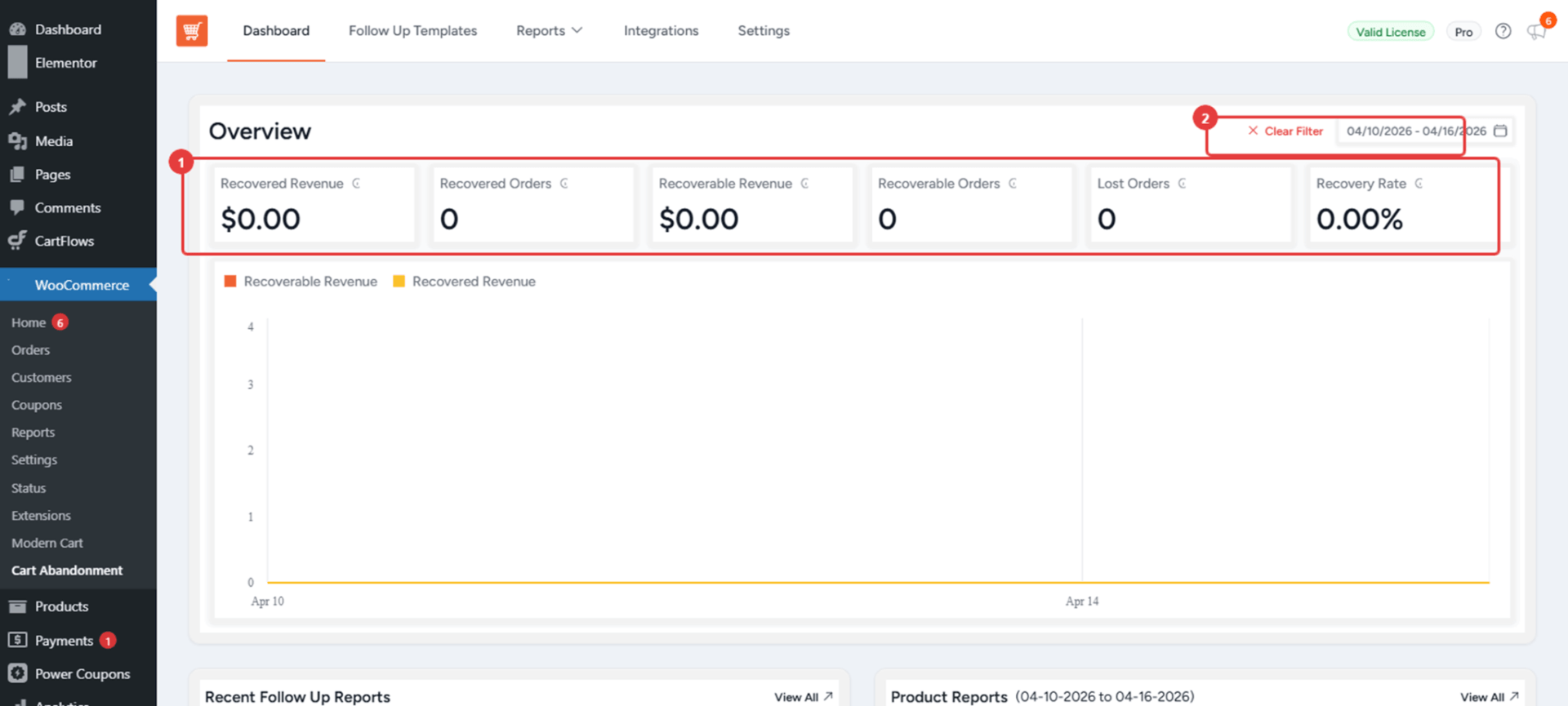
Six Stat Cards
| Metric | What It Means |
| Recovered Revenue | Total revenue generated through successful recoveries |
| Recovered Orders | Abandoned carts that converted into completed orders after recovery |
| Recoverable Revenue | Total order value of carts that are still eligible for recovery |
| Recoverable Orders | Carts currently in the recovery queue (emails being sent or scheduled) |
| Lost Orders | Carts that were not recovered within the configured “lost time” window |
| Recovery Rate | Percentage of abandoned carts that were successfully recovered |
Date Range Picker
Top-right of the Dashboard. Filter all stats and the chart by:
- Today / Yesterday / Last Week / Last Month
- Custom date range
Click Clear Filter to reset to all-time.
Revenue Chart
Below the stat cards: a two-series line chart showing Recoverable Revenue vs. Recovered Revenue over time. Useful for spotting trends and measuring campaign impact.
Reports > Follow Up
Go to WooCommerce > Cart Abandonment > Reports > Follow Up.
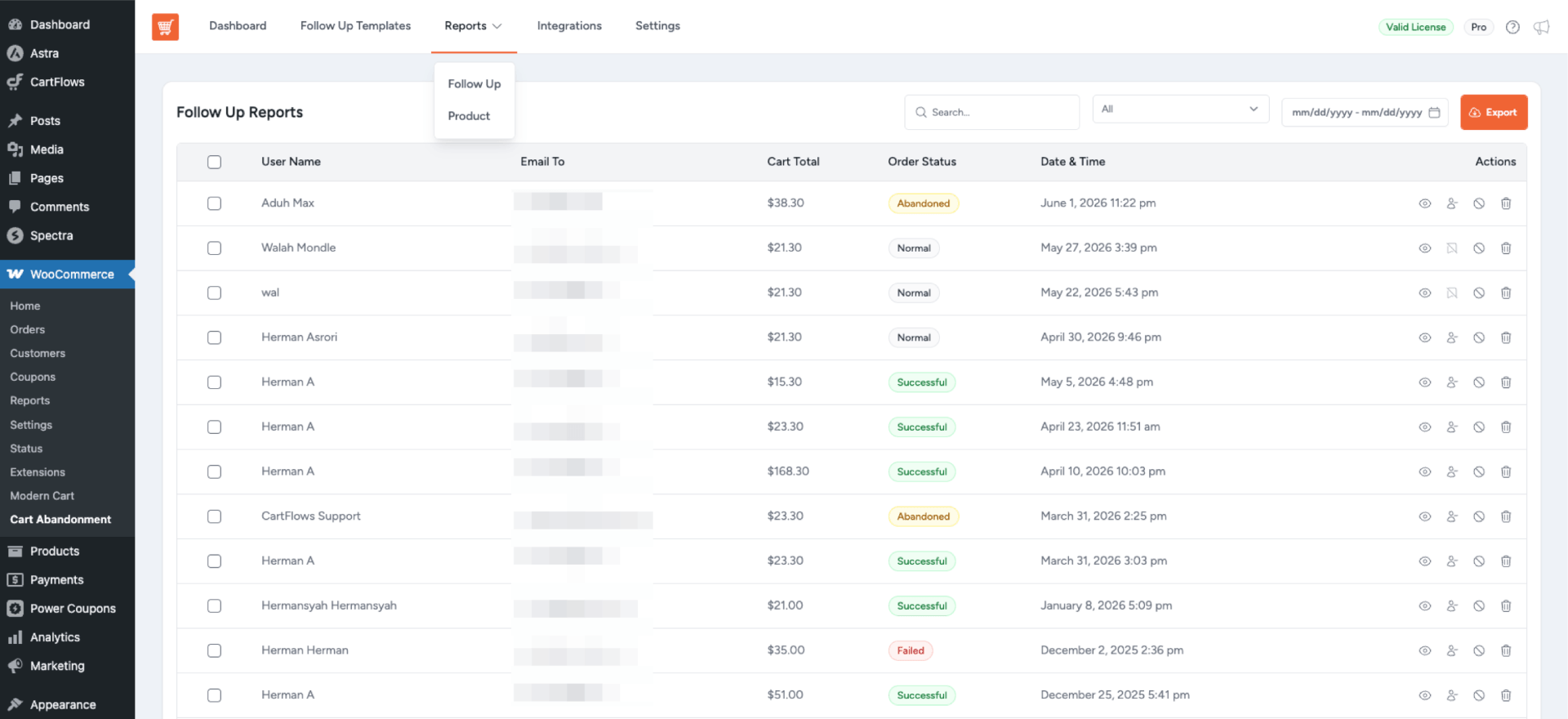
Controls
- Search by email
- Filter by status (All / Recoverable / Recovered / Lost)
- Date range picker (mm/dd/yyyy – mm/dd/yyyy)
- Export button — download a CSV of the filtered view
The Abandoned Carts Table
Each row represents one tracked cart:
| Column | Description |
| Customer Email | Shopper’s email address (primary identifier) |
| Order Total | Total value of the cart |
| Customer Name | Full name if provided at checkout |
| Status | Recoverable, Recovered, or Lost |
| Date Abandoned | When the cart was marked as abandoned |
| Actions | View details, unsubscribe, or delete |
Bulk Actions
Check multiple rows, then use the Bulk Actions dropdown:
- Delete selected carts
- Unsubscribe selected customers
Reports > Product (Pro)
Go to WooCommerce > Cart Abandonment > Reports > Product.
Shows which individual products appear most often in abandoned carts — useful for identifying high-abandonment SKUs and adjusting pricing, descriptions, or recovery offers accordingly.
Per-Template Metrics in Follow Up Templates (Pro)
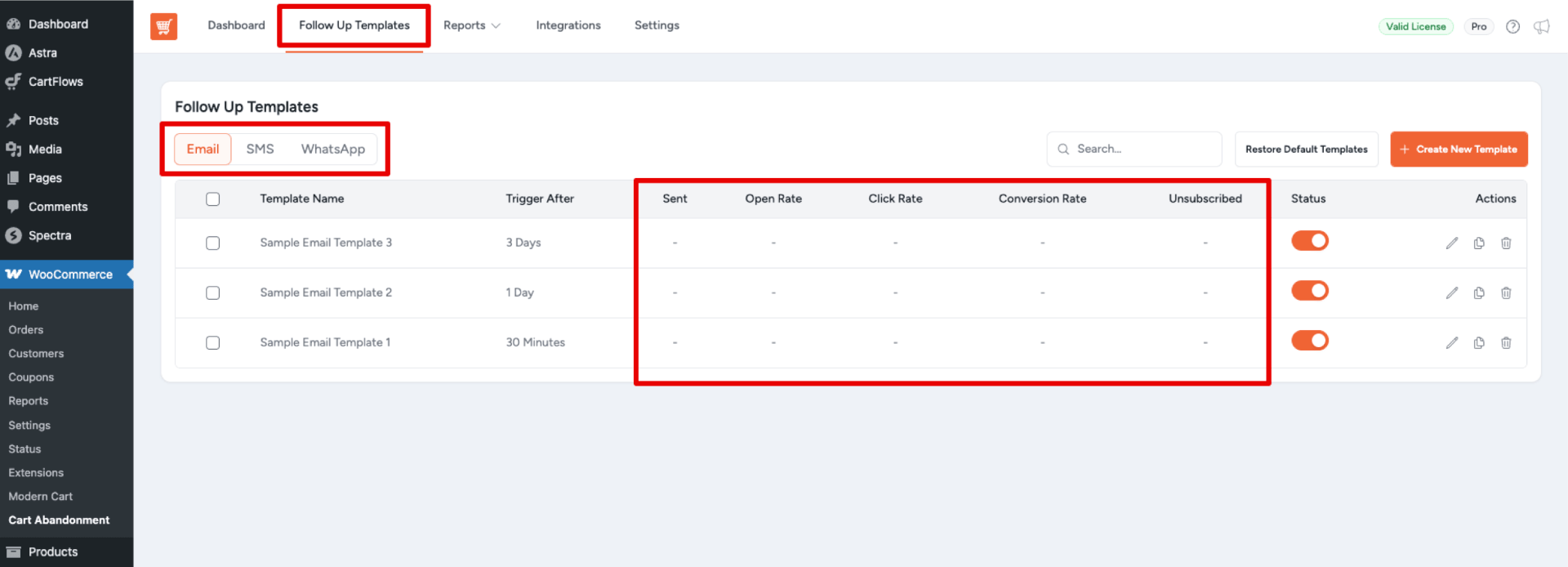
The Follow Up Templates list (under the Email sub-tab) shows per-template performance columns:
| Column | What It Means |
| Sent | Total emails sent from this template |
| Open Rate | % of sent emails that were opened |
| Click Rate | % of opened emails where a link was clicked |
| Conversion Rate | % that resulted in a recovered order |
| Unsubscribed | Number of unsubscribes triggered from this template |
Use these to compare which email in your sequence (e.g., 30-min vs. 1-day vs. 3-day) drives the most recoveries.
Recovery Report Emails
The plugin can automatically email a weekly recovery summary to one or more admin addresses.
Setup: Go to Settings > Recovery Report > enable Send Recovery Report Emails > enter admin email addresses (one per line).
This is helpful for store managers who want a regular digest without logging into WordPress every week.
Tips & Best Practices
- Check the Dashboard weekly — a sudden spike in Lost Orders may indicate an email deliverability issue.
- Compare date ranges — use custom ranges to measure the impact of changes in your templates or timing.
- Aim for a recovery rate of 10%+ — industry average for well-optimized campaigns.
- If Recovered Revenue is low but Recoverable Orders is high, your emails may not be landing in inboxes — check SPF/DKIM setup.
- Use per-template metrics to identify which email in your sequence earns the most conversions — then optimize timing and copy accordingly.
FAQs
We don't respond to the article feedback, we use it to improve our support content.