
WooCommerce powers 6,378,850 live websites and 4,151,703 live stores, and it holds 48.4% of all ecommerce systems whose platform is known. That’s a lot of commerce running on one open-source plugin. This page collects 80+ verified WooCommerce statistics on adoption, growth, geography, categories, themes, technology, security, and community, each traced to a primary source.
Key Statistics (at a Glance)
- 6,378,850 live websites currently use WooCommerce.[1]
- 4,151,703 live stores run on WooCommerce as of 2026 Q3.[2]
- 48.4% of all ecommerce systems with a known platform use WooCommerce.[3]
- 8.2% of all websites on the internet run WooCommerce.[3]
- 23,479 merchants left WooCommerce for other platforms in the last 90 days, versus 15,674 who joined.[2]
- 11.6% of WooCommerce stores use Astra, the most popular theme, at 480,229 stores.[2]
- 12.2% of WooCommerce stores are based in the United States.[2]
- 31.1% of WooCommerce stores sell just 1 to 9 products.[2]
- 11,334 new WordPress ecosystem vulnerabilities were found in 2025, up 42% year over year.[4]
- Key Statistics (at a Glance)
- WooCommerce Usage and Adoption
- WooCommerce Store Growth
- WooCommerce Market Share and Platform Switching
- Where WooCommerce Stores Are Located
- What WooCommerce Stores Sell
- How Big WooCommerce Stores Are
- Most Popular WooCommerce Themes
- The WooCommerce Technology Stack
- How WooCommerce Stores Market Themselves
- WooCommerce Security
- WooCommerce Community and Ecosystem
- Sources and Methodology
- Final Thoughts
- Frequently Asked Questions
- References
WooCommerce Usage and Adoption
As of 2026, 6,378,850 live websites currently use WooCommerce.[1] It’s a huge footprint for a free plugin.
- 6,378,850 live websites currently use WooCommerce.[1]
- 6,736,694 total websites have used WooCommerce, live plus historically detected.[1]
- 4,151,703 live stores run on WooCommerce as of 2026 Q3.[2]
- 8.2% of all websites on the internet run WooCommerce.[3]
- 11.7% of all sites whose CMS is known run WooCommerce.[3]
- 7 million plus active installs of the WooCommerce plugin.[5]
- 41.2% of all websites run on WordPress, the base WooCommerce depends on.[3]
Those first three numbers look different for a reason. BuiltWith counts every live website where it detects WooCommerce code, whether or not the site is actively selling, which is how it reaches 6,378,850.[1] Store Leads counts live, active storefronts with a working catalog, a narrower definition that lands at 4,151,703.[2] Neither is wrong. One measures WooCommerce installed, the other measures WooCommerce actively running a store.
If you’re already building on WordPress, a funnel builder for WordPress slots right into that stack.
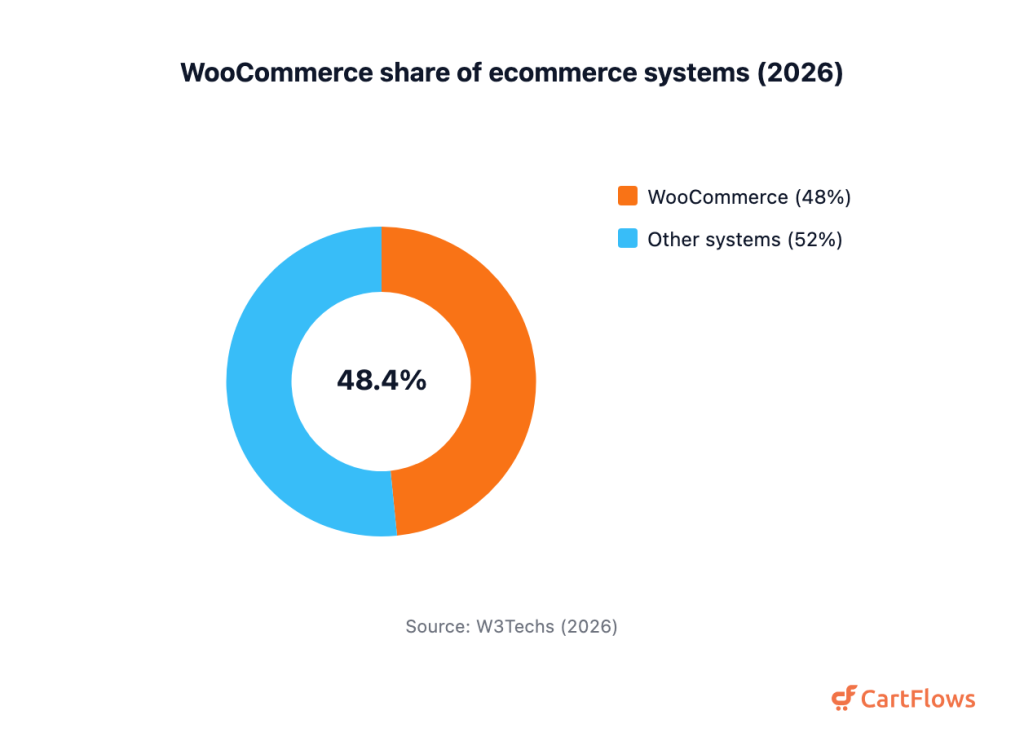
WooCommerce runs on 48.4% of all ecommerce systems with a known platform. Source: W3Techs (2026).
WooCommerce Store Growth
WooCommerce grew from 1,435,039 live stores in 2020 Q1 to a peak of 4,776,386 in 2024 Q2.[2] That’s more than a tripling in four years.
- 1,435,039 live WooCommerce stores in 2020 Q1.[2]
- 4,776,386 live stores at the 2024 Q2 peak.[2]
- 4,467,654 live stores by 2025 Q4.[2]
- 4,151,703 live stores by 2026 Q3.[2]
- 1.7% quarter over quarter drop in live stores in 2026 Q2.[2]
- 8% year over year drop in live stores in 2026 Q2.[2]
The plateau doesn’t mean WooCommerce is fading. It means the land-grab phase is over, and store counts now track churn as much as new signups.
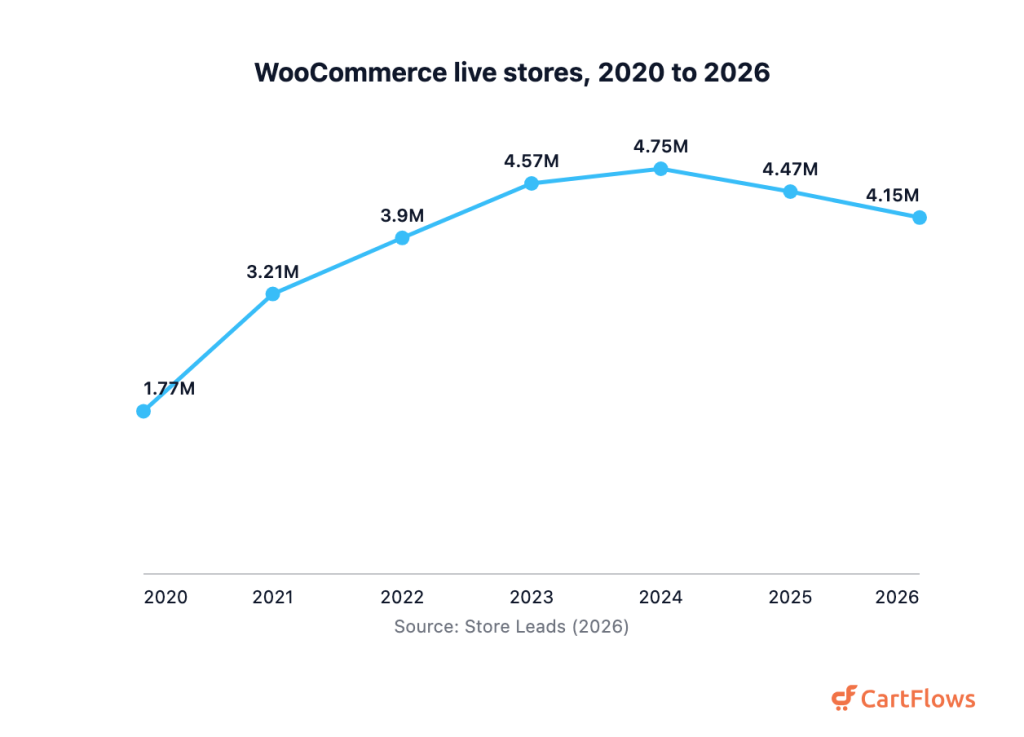
Live stores nearly tripled from 2020, peaked in 2024, then cooled. Values in millions. Source: Store Leads (2026).
Store counts from Store Leads’ historical series, taken at year-end except the 2026 row, which is the latest 2026 Q3 figure since the year is not over (the 1,435,039 figure above is Q1 2020, not year-end):[2]
| Year | Live WooCommerce stores |
|---|---|
| 2020 | 1.77M |
| 2021 | 3.21M |
| 2022 | 3.9M |
| 2023 | 4.57M |
| 2024 | 4.75M |
| 2025 | 4.47M |
| 2026 (Q3, latest) | 4.15M |
WooCommerce Market Share and Platform Switching
WooCommerce is used by 48.4% of all ecommerce systems whose platform is known.[3] That headline share makes it look untouchable. But the migration data cuts the other way.
- 48.4% of all ecommerce systems with a known platform use WooCommerce.[3]
- 15,674 merchants joined WooCommerce from other platforms in the last 90 days.[2]
- 4,545 of those joiners switched from custom carts.[2]
- 3,935 switched from Shopify.[2]
- 2,330 switched from Wix.[2]
- 23,479 merchants left WooCommerce for other platforms over the same 90 days.[2]
- 9,622 of those leavers moved to Shopify.[2]
- 9,374 moved to custom carts.[2]
So the “runaway leader” framing you’ll read elsewhere is stale, because more merchants are leaving than arriving. If you’re weighing the trade-offs, our WooCommerce vs Shopify breakdown covers where each one wins, and a modern cart for WooCommerce closes much of the checkout gap that pushes stores toward hosted platforms.
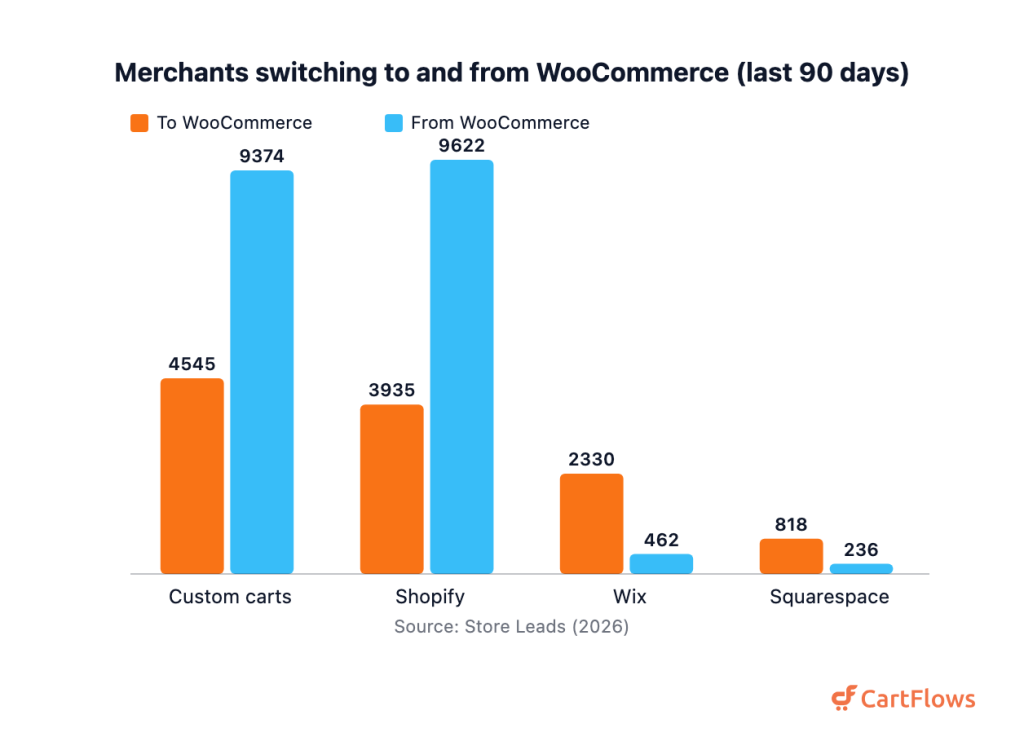
Over 90 days WooCommerce gained 15,674 merchants but lost 23,479, most of them to Shopify. Source: Store Leads (2026).
- Over the trailing 90 days, Squarespace sent 818 stores to WooCommerce and pulled 236 away, while 462 stores left WooCommerce for Wix.[2]
Where WooCommerce Stores Are Located
The United States hosts 12.2% of all WooCommerce stores, roughly 507,930 of them.[2] No other country comes close.
- 12.2% of WooCommerce stores are in the United States, about 507,930 stores.[2]
- 4.3% are in the United Kingdom.[2]
- 3.2% are in India.[2]
- 2.9% are in Germany.[2]
- 49.3% of WooCommerce stores use a .com domain.[2]
Europe fills out the rest, with Italy, the Netherlands, Spain, France, and Brazil rounding out the top nine.[2] That .com lean shows you how many stores chase an international look, even outside the US.
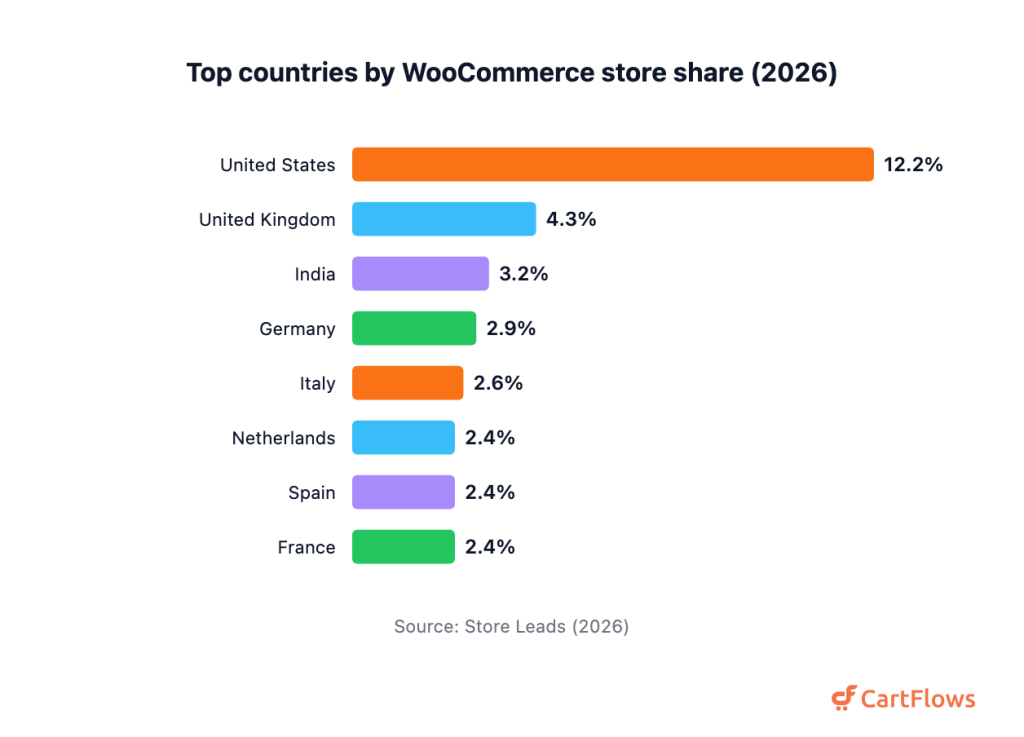
The United States hosts more WooCommerce stores than the next four countries combined. Source: Store Leads (2026).
- By country share: United States 12.2%, United Kingdom 4.3%, India 3.2%, Germany 2.9%, Italy 2.6%, and the Netherlands, Spain, and France about 2.4% each.[2]
What WooCommerce Stores Sell
Home and Garden is the single most common WooCommerce vertical, at 11.3% of stores.[2] It’s a broad spread, not one dominant niche.
- 11.3% of WooCommerce stores sell Home and Garden products.[2]
- 8.6% sell Apparel.[2]
- 7.7% sell Business and Industrial goods.[2]
- 7.3% sell Food and Drink.[2]
- 5.6% sell Beauty and Fitness products.[2]
- 5.5% sell Health products.[2]
The takeaway is variety. WooCommerce isn’t concentrated in a single category, which is exactly what you’d expect from an open platform anyone can extend.
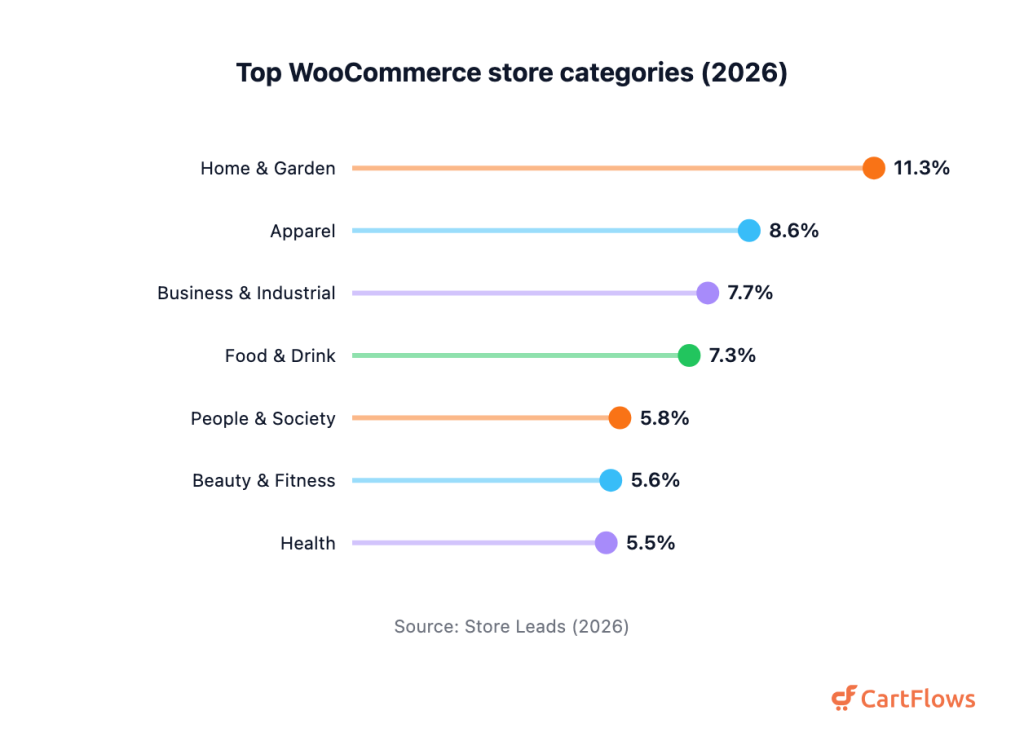
Home and Garden is the single largest WooCommerce vertical. Source: Store Leads (2026).
- Leading store categories: Home & Garden 11.3%, Apparel 8.6%, Business & Industrial 7.7%, Food & Drink 7.3%, People & Society 5.8%, Beauty & Fitness 5.6%, and Health 5.5%.[2]
How Big WooCommerce Stores Are
Most WooCommerce stores are small catalogs, with 31.1% selling just 1 to 9 products.[2] The long tail of tiny shops is the real story here.
- 31.1% of WooCommerce stores sell just 1 to 9 products.[2]
- 12.7% sell 10 to 24 products.[2]
- 10.7% sell 25 to 49 products.[2]
- 98.4% of stores don’t publicly list an employee count.[2]
- 0.7% list 1 to 9 employees.[2]
- 0.3% list 10 to 24 employees.[2]
Small catalogs change what matters. When you sell nine products, every extra order counts, so upsells and a smooth checkout move the needle more than a giant catalog does. Our guide to WooCommerce upsell plugins covers the fastest wins there.
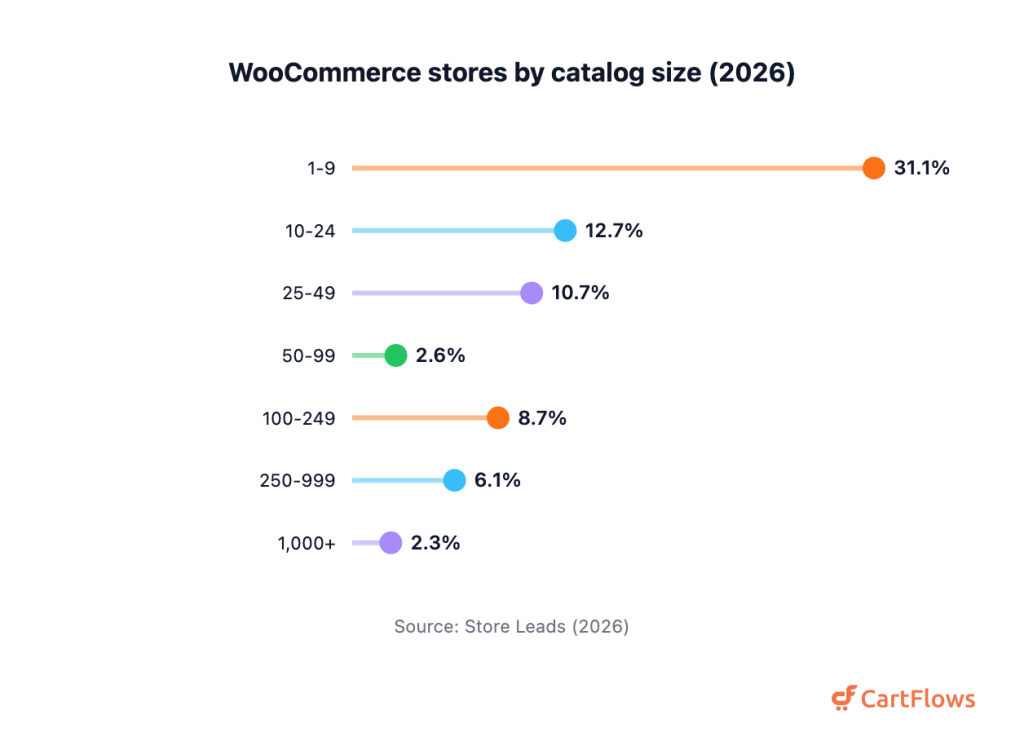
Most WooCommerce stores are small: nearly a third sell fewer than 10 products. Source: Store Leads (2026).
- By catalog size: 1 to 9 products 31.1%, 10 to 24 12.7%, 25 to 49 10.7%, 50 to 99 2.6%, 100 to 249 8.7%, 250 to 999 6.1%, and 1,000 or more 2.3%.[2]
Most Popular WooCommerce Themes
Astra is the most popular WooCommerce theme, running on 11.6% of stores, or 480,229 sites.[2] It’s the clear leader, but not by a landslide.
- 11.6% of WooCommerce stores use Astra, or 480,229 sites.[2]
- 8.6% use Hello Elementor.[2]
- 6.0% use Flatsome.[2]
- 5.3% use Divi.[2]
- 4.5% use Woodmart.[2]
- 1,500 plus WooCommerce themes are listed on ThemeForest.[6]
- 1,012 WooCommerce themes show up in the WordPress.org directory.[7]
So no single theme owns the market. Even the leader covers barely one store in nine, which tells you how fragmented and customizable WooCommerce design really is.
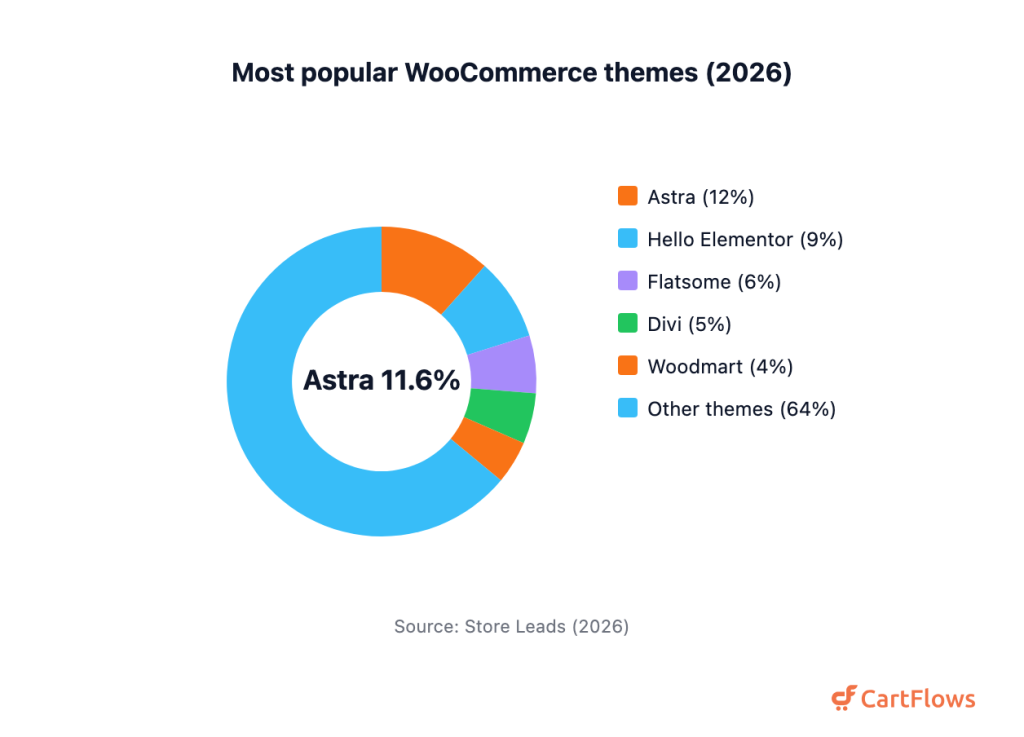
Astra leads a fragmented theme market where no single theme tops 12%. Source: Store Leads (2026).
The WooCommerce Technology Stack
WooCommerce stores collectively run 805 different third-party technologies, totaling 20,307,071 installs.[2] The foundation stays consistent, though.
- 805 different third-party technologies run across WooCommerce stores, with 20,307,071 installs combined.[2]
- 97.8% of WooCommerce stores run on WordPress.[2]
- 38.8% of stores use Google Tag Manager.[2]
- 36.8% use Google AdSense.[2]
- 35.2% use Yoast.[2]
- 26.5% use Facebook Pixel.[2]
- 24.3% use Google Analytics.[2]
- 17.4% use Cloudflare.[2]
- 10.5% of stores run WooPayments, the most-installed app, or 436,895 sites.[2]
- 5.0% run Mailchimp for WooCommerce, about 209,585 stores.[2]
- 893,439 app installs are detected across 45 trackable WooCommerce apps.[2]
Beyond that, the official marketplace lists hundreds more free and paid extensions.[8] It’s a stack most merchants build up one tool at a time.
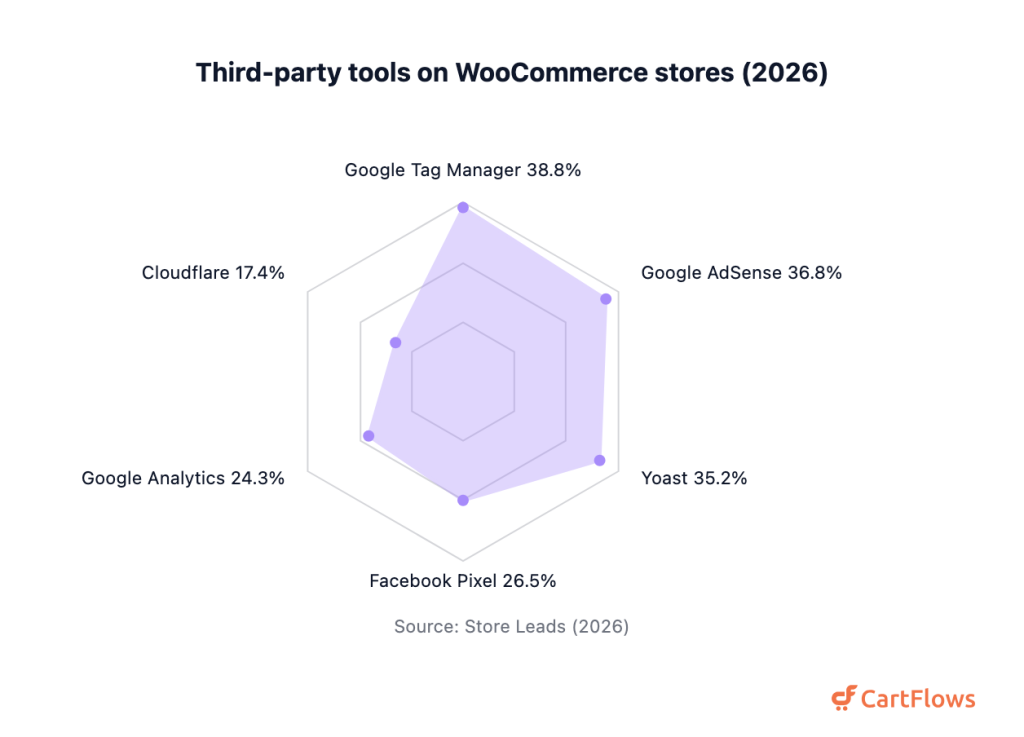
Tracking and SEO tools dominate the typical WooCommerce tech stack. Source: Store Leads (2026).
How WooCommerce Stores Market Themselves
Instagram is the most common social channel for WooCommerce stores, with 39.4% linking a presence.[2] The newer channels lag well behind.
- 39.4% of WooCommerce stores have an Instagram presence.[2]
- 35.8% use Facebook.[2]
- 13.5% use YouTube.[2]
- 9.5% link Twitter/X.[2]
- 8.1% link LinkedIn.[2]
- 7.1% link WhatsApp.[2]
- 5.0% link TikTok.[2]
- 57% of stores list a phone number on their site.[2]
- 55% list an email address.[2]
Social reach is only half the job. Getting shoppers to finish checkout is the other half, and stores that recover abandoned carts keep more of the traffic they earn. If you want the tactical version, here’s how to reduce cart abandonment on WooCommerce specifically.
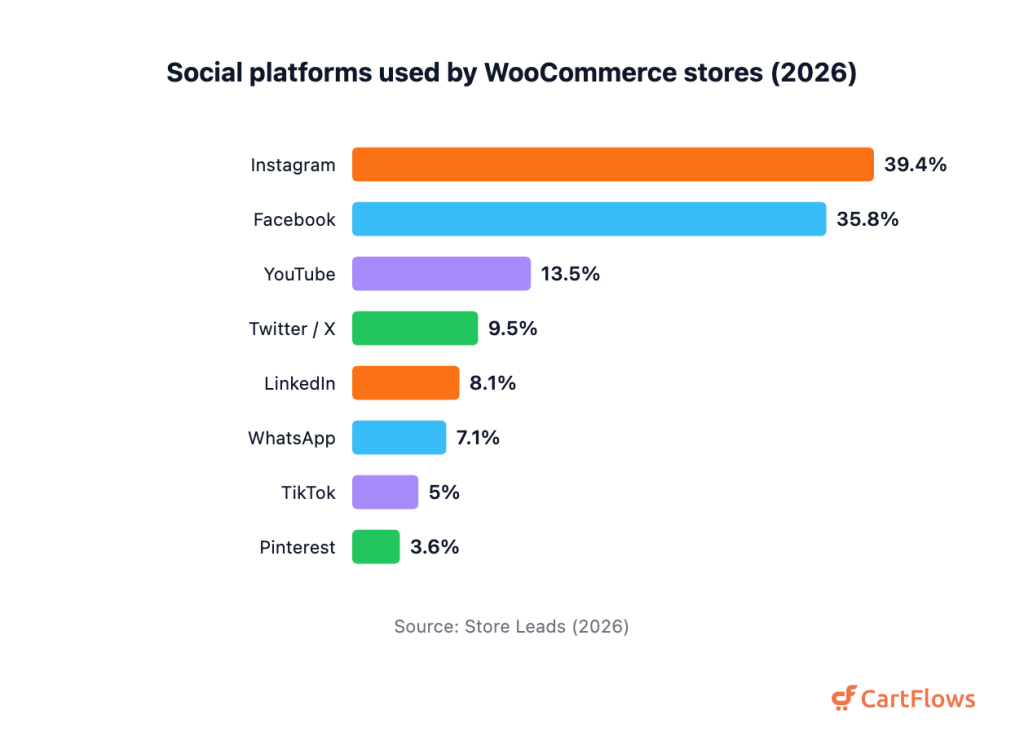
Instagram and Facebook are the default marketing channels for WooCommerce merchants. Source: Store Leads (2026).
- Social presence across stores: Instagram 39.4%, Facebook 35.8%, YouTube 13.5%, X 9.5%, LinkedIn 8.1%, WhatsApp 7.1%, TikTok 5.0%, and Pinterest 3.6%.[2]
WooCommerce Security
The WordPress ecosystem recorded 11,334 new vulnerabilities in 2025.[4] The number sounds scary until you see where the risk actually lives.
- 11,334 new WordPress ecosystem vulnerabilities were found in 2025.[4]
- 42% jump in vulnerabilities from 7,966 in 2024.[4]
- 91% of those 2025 vulnerabilities were in plugins, not WordPress core.[4]
- 6 vulnerabilities were reported in WordPress core in 2025, all low priority.[4]
- 8.7 million plus exploit attempts were blocked in about two days during an October 2025 plugin-installation attack wave.[9]
So the practical lesson is simple. Vet your plugins, patch fast, and keep the list short, because the add-ons are where the danger sits.
WooCommerce Community and Ecosystem
WooCommerce is backed by a large open-source community, with the core plugin listing 52 contributors.[5] That community reaches well beyond code.
- 52 contributors are listed on the WooCommerce core plugin.[5]
- 208 locales have a WordPress translation, the base WooCommerce runs on.[10]
- WordCamp community events have run since 2006 across dozens of countries, sustaining WooCommerce’s contributor base.[11]
It’s the kind of ecosystem depth you don’t get with a closed platform. And it’s a big reason merchants stick around even as the numbers wobble.
Sources and Methodology
We built this page from primary sources only. Live-site and store counts come from Store Leads, W3Techs, and BuiltWith. Plugin and community figures come from WordPress.org, translation data from WordPress Polyglots, security data from Patchstack and Wordfence, and theme counts from ThemeForest and the WordPress.org directory. The store-level data was last updated in July 2026.
We traced every figure back to its original source and dropped the ones we couldn’t confirm. That’s why you won’t see two widely repeated claims here: the roughly $30 to 35 billion annual sales figure and the $122 average order value. No primary source verified either one, so we left them out rather than pass along numbers we can’t stand behind.
Final Thoughts
The numbers tell a more grown-up story than the usual headlines. WooCommerce is still the biggest ecommerce platform by share, but it’s past its explosive growth phase, and slightly more merchants are leaving than joining. That’s not a decline worth panicking over. It’s a market maturing.
Here’s our honest read. The stores that thrive from here won’t be the ones that simply launched on WooCommerce; they’ll be the ones that treat conversion, checkout, and retention as first-class problems. The platform gives you the reach and the flexibility. What you do with it is what actually decides the outcome.
Frequently Asked Questions
References
1. BuiltWith
2. Store Leads
3. W3Techs
4. Patchstack
6. ThemeForest
8. WooCommerce
9. Wordfence
11. WordCamp Central