A tripwire funnel is a sales funnel strategy that converts new leads into paying customers by presenting a low-cost, high-value offer ($7–$27) immediately after they opt in, making the first purchase feel like a no-brainer.
Key facts:
- The hardest sale to make is the first one. A tripwire removes that barrier with a micro-commitment.
- Existing customers are significantly more likely to purchase again compared to free subscribers. Some industry benchmarks put the probability of selling to an existing customer at up to 14 times higher than selling to a new prospect.
- A well-optimized tripwire funnel can offset your entire ad spend, acquiring customers for effectively $0.
- You can pair your tripwire with order bumps and upsells to maximize average order value from day one.
If you’re spending money on ads or building an email list but struggling to turn subscribers into customers, a tripwire funnel fixes that gap.
TL;DR: A tripwire funnel places a low-cost product ($7–$27) immediately after your lead magnet opt-in to convert free subscribers into paying customers on the spot. When paired with order bumps and upsells, the front-end revenue can cover your entire ad spend, so every future sale is pure profit. You can build the full flow inside WordPress using WooCommerce and CartFlows.
Is this guide for you? This guide is for WooCommerce store owners, course creators, and coaches who want to stop building lists of freebie-seekers and start building lists of buyers.
A tripwire funnel is a sales funnel strategy that converts leads into paying customers by offering a low-cost, high-value product, typically priced between $7 and $27, right after someone opts into your email list.
Think of your lead magnet as the handshake. Your tripwire is the first deal. And once someone buys from you, even for $7, they’ve crossed a psychological line. They’re a customer now. Customers buy again.
Russell Brunson built ClickFunnels on this model. DigitalMarketer scaled with a $7 toolkit. The psychology is universal, and in this guide, you’ll learn exactly how to use it for your store.
Here’s what we’ll cover:
- Why the first sale matters more than the next ten
- How a tripwire funnel works (every component, explained)
- What makes a good tripwire offer (with ideas by business type)
- How to build one step by step using WordPress and CartFlows
- What metrics to track and which mistakes to avoid
Why Does a Tripwire Funnel Matter?
The uncomfortable truth about email lists: most subscribers never buy anything.
Industry data shows that the average email list converts at 1–2% to paid customers. You could have 10,000 subscribers and only 100–200 of them ever spend a dollar. That’s a lot of nurturing for very little return.
A tripwire funnel flips this problem on its head. Instead of waiting weeks or months for a subscriber to warm up, you present a small, irresistible offer immediately. The ones who buy are worth dramatically more than those who don’t.
Why? Because of a principle psychologists call commitment and consistency. Robert Cialdini documented this in Influence: The Psychology of Persuasion: when someone makes even a small purchase, they’ve mentally committed to your brand. They’ve taken out their credit card, entered their details, and clicked “buy.” That micro-commitment changes their self-perception. They think: “I’m the kind of person who buys from this brand.”
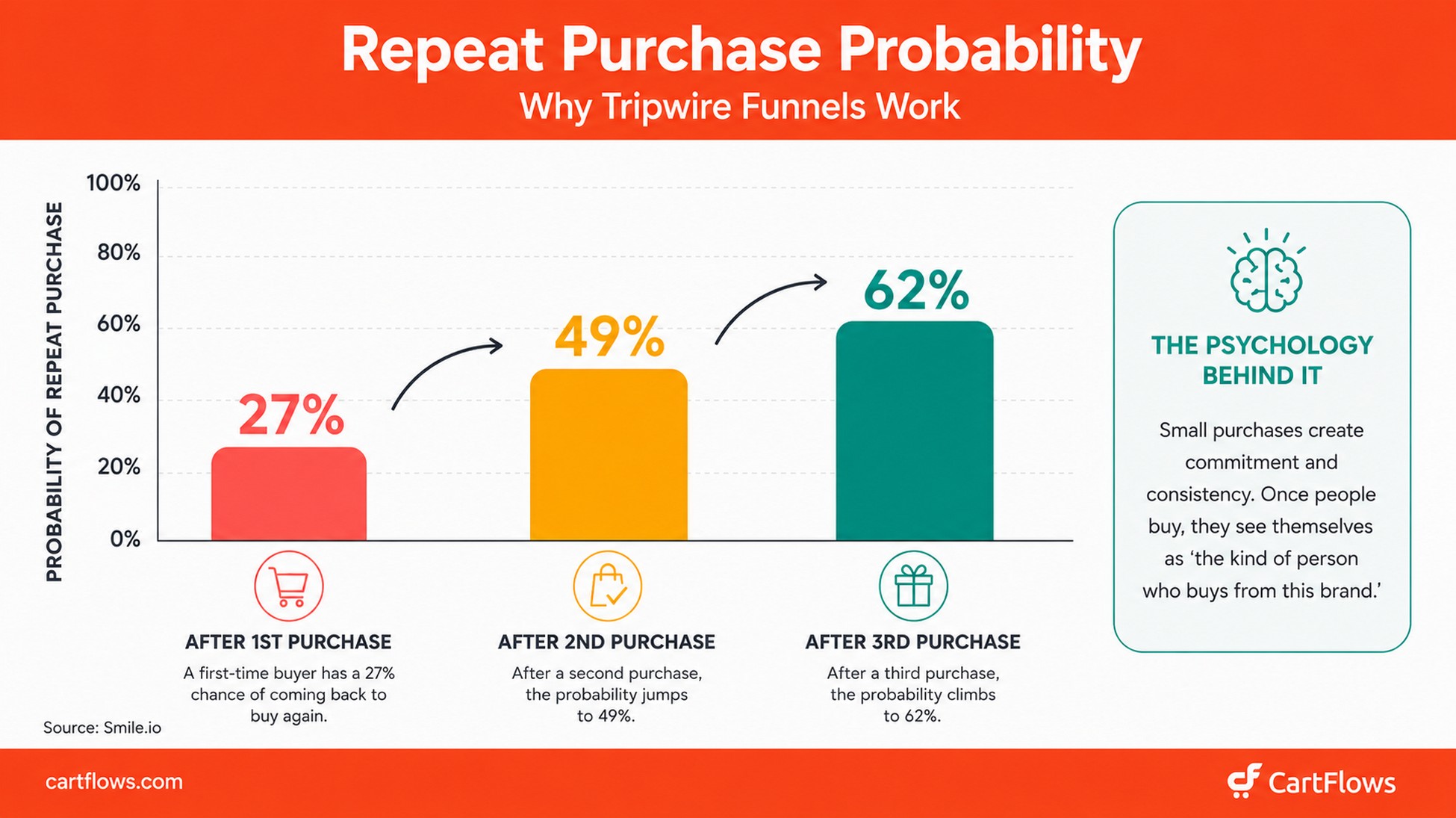
The data backs this up. After a first purchase, a customer has a 27% chance of returning to buy again. After a second purchase, that jumps to 49%. And after a third, it climbs to 62%. A list of 100 buyers will consistently outperform a list of 1,000 freebie-seekers in revenue, engagement, and lifetime value.
But there’s a second reason tripwire funnels matter, and it’s financial. When you optimize a tripwire funnel properly, with an order bump and an upsell sequence, the revenue from your low-ticket sales can cover your entire ad spend. This is what marketers call a self-liquidating offer. You’re acquiring customers for free. Every sale after that is pure profit.
A common misconception: some marketers think you need a massive email list before a tripwire funnel makes sense. In our experience, the opposite is true. The earlier you introduce a tripwire, the faster you identify who’s actually willing to buy. That changes everything about how you spend your ad budget and write your emails.
Does a tripwire funnel matter? If you’re spending money to build an email list, it’s arguably the single most important funnel you can build.
How Does a Tripwire Funnel Work?
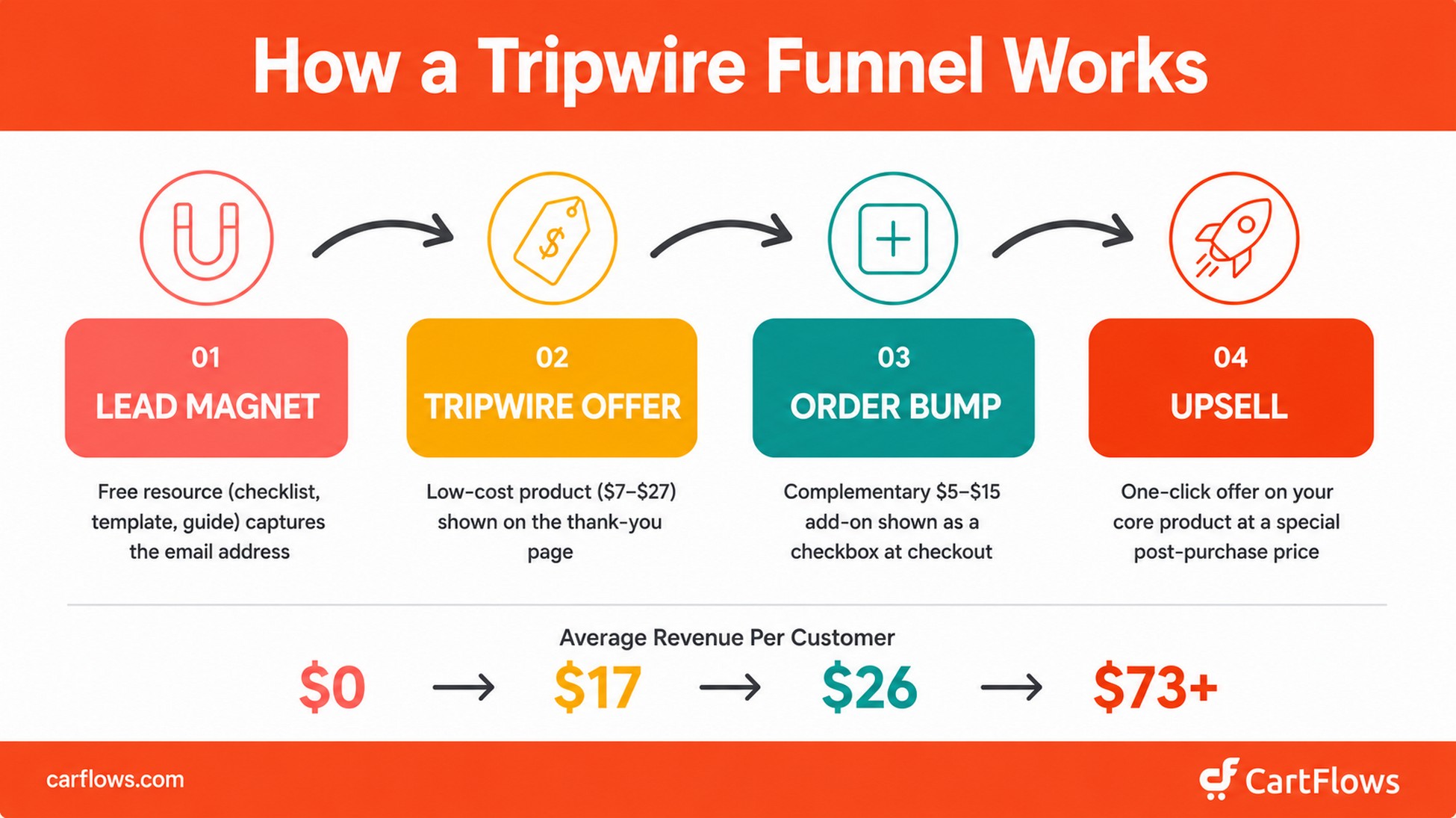
A tripwire funnel has four core components that work together in sequence. Each one serves a specific purpose in moving a stranger from “never heard of you” to “just bought from you.”
Here’s the flow your customer experiences:
Component 1: The Lead Magnet
This is the free resource that gets someone to give you their email address. It could be a checklist, a mini-training, a template pack, a cheat sheet, or a short guide. The lead magnet’s only job is to attract the right people and earn enough trust to get them to opt in.
The key here, and most people get this wrong, is that your lead magnet must be directly related to your tripwire offer. If your lead magnet is about Instagram growth but your tripwire is a course on email marketing, the disconnect kills your conversion rate.
Component 2: The Tripwire Offer
This is the low-cost product you present immediately after someone opts in, typically on the thank-you page itself. The price is low enough to be an impulse buy ($7–$27 is the sweet spot), but the perceived value is much higher.
What makes this work is timing. The person just took an action (opted in). They’re engaged. They’re on your page. And you’re saying: “Hey, before you go, I have something that takes what you just downloaded to the next level. It’s $17.”
That’s a much easier sale than sending a promotional email three days later.
Component 3: The Order Bump
An order bump is a small add-on offer that appears directly on the checkout page, usually as a checkbox. When someone is already buying your $17 tripwire, offering a complementary $9 add-on (worksheets, templates, a bonus module) feels like a no-brainer.
Order bumps convert at 30–40% on average, based on data from platforms processing billions in transactions. That means for every 10 people who buy your tripwire, 3–4 of them will also grab the bump. Your average order value just jumped from $17 to $24+ without any extra selling.
Component 4: The Upsell and Downsell
After checkout, the customer lands on an upsell page, a one-time offer on your core product at a special price. This is where the real revenue lives. If the customer accepts, great. If they decline, you show a downsell, a lighter version at a lower price.
Typical upsell conversion rates sit around 5–10% for cold funnels and can reach 15–25% for warm audiences with a strong offer-to-tripwire match. Downsells convert at 5–10%. Combined with the tripwire and the bump, you’ve turned a $7–$27 front-end sale into $40–$80+ in average revenue per customer.
So how does all of this work together? A visitor sees your store’s ad, clicks through, grabs your free checklist, sees a $17 mini-course on the thank-you page, adds the $9 worksheet bundle at checkout, and then sees a one-time offer on your flagship $97 course for just $47. Even if only a fraction accept the upsell, your front-end revenue covers your ad spend, and every future email you send to that buyer is pure profit.
That’s the tripwire funnel in action.
Every component earns its place. Remove any one, and the economics break.
Why Not Just Sell Your Core Product Directly?
Fair question. Adding a $17 step in front of a $197 product seems like unnecessary friction. But a tripwire funnel does something a direct-sales page can’t: it converts cold traffic into buyers on the first visit.
The math tells the story. When your store’s front-end revenue (tripwire + bump + upsell) covers your cost per lead, you’re acquiring customers for free. Every future sale is pure profit. Marketers call this a self-liquidating funnel, and it’s why companies like DigitalMarketer and Agora Financial scaled to eight figures. They weren’t paying for customers; their tripwire funnels were.
But the financial benefit is only half the picture. A tripwire also separates your buyers from your browsers. Not all subscribers are equal, and your store needs to know who’s willing to spend money so you can market your premium offers to that segment, specifically, email segmentation.
There’s a compounding effect, too. Someone who buys once is significantly more likely to buy again. The tripwire starts that purchasing behavior on day one, not week six of an email nurture sequence. And because the entire flow is automated (opt-in → tripwire → upsell → email sequence), it runs 24/7 once you set it up.
We’ve seen this play out across CartFlows users: stores that add a tripwire funnel to their existing lead magnet flow consistently see higher email engagement rates and stronger backend conversion on their core offers. The $7 purchase isn’t about the $7. It’s about building a buyer relationship from the first interaction.
One caveat, though. If your core offer is already priced under $50, say a $29 ebook, adding a $7 tripwire in front of it creates unnecessary friction. Tripwires work best when the gap between the tripwire price and the core offer price is large enough that the tripwire feels like a genuine stepping stone, not just a discount.
Further reading: How to Increase Average Order Value in WooCommerce
Tripwire Funnel vs Lead Magnet Funnel vs SLO: What’s the Difference?
These three terms get mixed up constantly. Here’s how they actually differ:
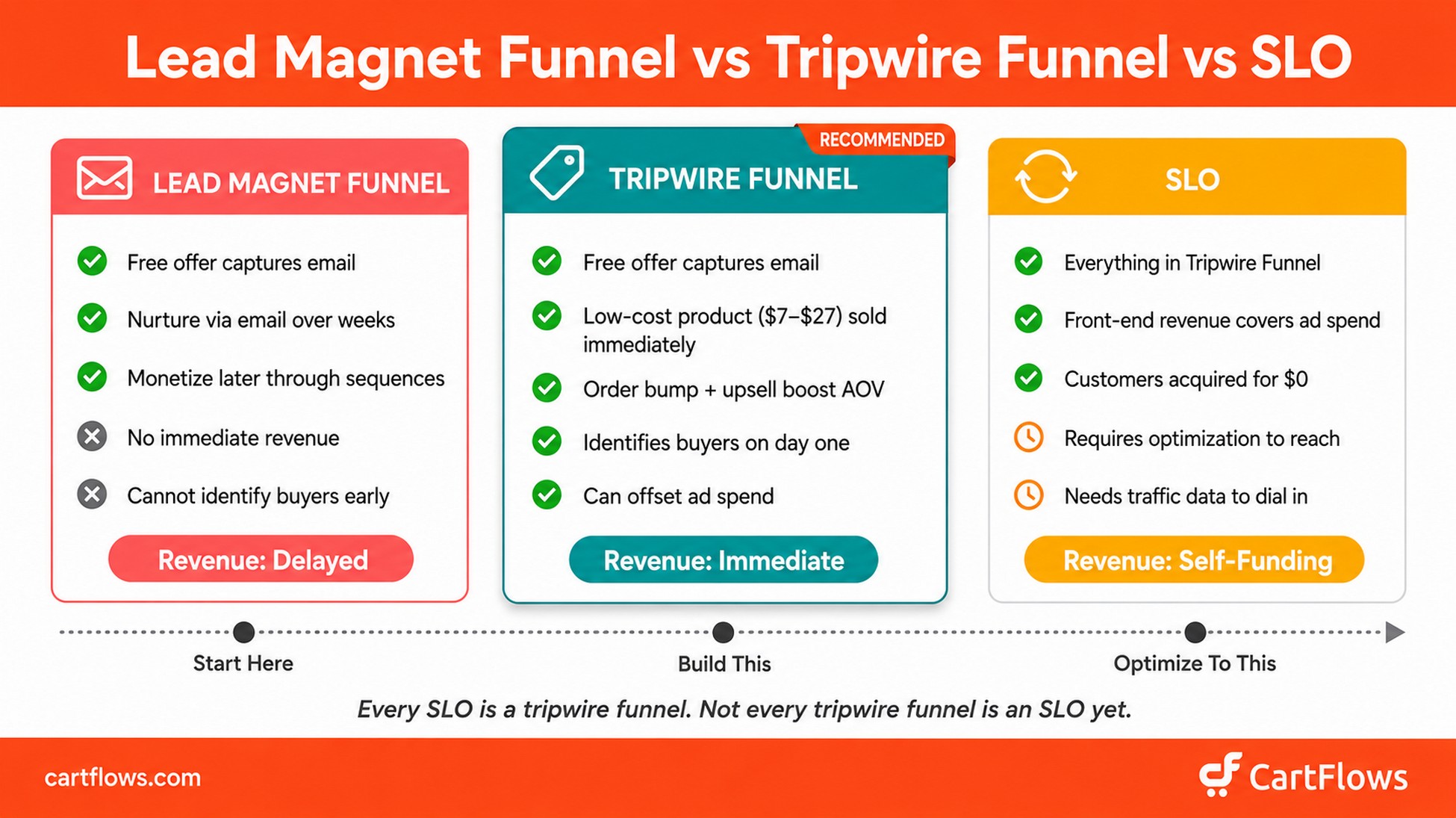
A lead magnet funnel is the simplest version. You offer something free in exchange for an email address, then nurture that subscriber with emails until they buy. There’s no immediate paid offer. The monetization happens later through your email sequence.
A tripwire funnel adds a paid offer immediately after the opt-in. The visitor gets the lead magnet AND sees a low-ticket product on the thank-you page. The key difference: money enters the equation within minutes, not days or weeks.
A self-liquidating offer (SLO) is a tripwire funnel that’s been optimized to the point where the front-end revenue covers the ad spend entirely. Not every tripwire funnel is an SLO, but every SLO is a tripwire funnel that’s been dialed in.
So what’s the difference between a tripwire and an SLO? Structure is the same. The distinction is financial: an SLO has been optimized until revenue equals or exceeds ad cost. A tripwire funnel that hasn’t reached that break-even point yet isn’t technically self-liquidating, but it’s on the path.
Which should you use? If you’re just starting out, build a tripwire funnel first. Get the mechanics working: lead magnet, low-ticket offer, order bump, upsell. Once your numbers are dialed in and your front-end revenue covers your ad spend, you’ve got yourself an SLO.
Start with the funnel. The self-liquidation comes from optimization.
What Makes a Good Tripwire Offer?
Not every low-cost product works as a tripwire. The best tripwire offers share five characteristics:
1. Priced in the impulse zone. The sweet spot is $7–$27. Below $7, people question the value (“if it’s that cheap, is it any good?”). Above $27, it stops being an impulse purchase and requires real consideration.The goal is for the buyer to think: “Why not? It’s less than a lunch.”
2. Directly related to the lead magnet. Your tripwire must feel like the natural next step after the freebie. If someone downloaded a checklist for writing sales pages, the tripwire should be a sales page template pack or a mini-course on copywriting, not a random product from your catalog.
Think of your lead magnet as the movie trailer and your tripwire as the first episode. Same story. Same promise. Just deeper.
3. High perceived value relative to price. The buyer should feel like they’re stealing it. A $17 product that looks and feels like it should cost $97 creates the “wow” moment that makes them trust your more expensive offers later.
4. Low cost to deliver. Digital products are ideal: templates, mini-courses, workshop replays, swipe files, resource libraries. Physical products work too (Russell Brunson’s “free plus shipping” book model), but digital products have near-zero marginal cost, which keeps your margins healthy.
5. Gives a quick win. The tripwire should deliver a result fast. Not a 40-hour course. Not a 200-page ebook. Something the buyer can use today and get value from immediately.
Speed matters more than depth here.
Tripwire Ideas by Business Type
If you run a WooCommerce store: Your store could offer a starter bundle at cost, a sample pack, a “$1 trial” of a subscription product, or a deep discount on a best-seller with an upsell to the full-priced version. If your store sells skincare, a $9 sample kit with 3 bestsellers makes a perfect tripwire. The upsell is the full-size bundle.
If you’re a course creator: A mini-course (the first 2–3 modules of your flagship), a workshop replay, a resource vault, or a “quick start” action guide. If your flagship is a $497 copywriting course, a $19 “headline writing” mini-course gives buyers a taste of your teaching style.
If you’re a coach or consultant: A strategy template, a self-assessment tool, a recorded masterclass, or a 7-day challenge for $7.
If you sell digital products: A template pack, a swipe file, a design asset bundle, or a tool with limited features (upgrade to unlock everything).
Tripwire Funnel Examples That Convert
Real businesses have used tripwire funnels to drive serious revenue. A few examples worth studying:
DigitalMarketer: The $7 Toolkit
DigitalMarketer built their empire on this model. They offered a “$7 social media swipe file” as a tripwire after a free lead magnet opt-in. The toolkit was packed with templates and scripts that felt worth $50+. After purchase, buyers saw an upsell for their full certification program. This single funnel generated millions in revenue and became one of the most referenced case studies in digital marketing.
Russell Brunson: Free Plus Shipping Books
Russell Brunson gives away his books for free and charges $7.95 for shipping. That $7.95 is the tripwire. Buyers then see an upsell for his Funnel Hacking Secrets training, One Funnel Away Challenge, or ClickFunnels subscription. The books themselves cost a few dollars to print and ship, but the lifetime value of a book buyer is worth hundreds because the book creates trust and the upsell sequence monetizes it.
Netflix: Low-Cost Entry Plans
Netflix introduced low-cost, mobile-only streaming plans in markets like India (starting in 2019) and later Malaysia and other regions. These plans weren’t designed to be profit centers on their own. They functioned as entry points: get users into the ecosystem, let them experience the content library, and then many naturally upgrade to standard or premium plans over time. The principle is the same as a tripwire: reduce the barrier to the first transaction, then let the product experience drive upgrades.
AppSumo: Lifetime Deal Bundles
AppSumo uses heavily discounted lifetime deals as tripwires. A $49 lifetime deal on software that normally costs $29/month introduces users to the AppSumo marketplace. Once they’ve bought one deal and had a great experience, they keep coming back for more. The first deal acquires the customer; the marketplace retains them.
The pattern across all these examples? The tripwire isn’t designed to generate massive profit on its own. It’s designed to create a buyer. Everything after that, the upsell, the email sequence, the core offer, is where the real money lives.
We’ve tested this across dozens of CartFlows user funnels. The stores that treat their tripwire as a customer-acquisition tool, not a profit center, consistently outperform the ones trying to make money on the front end.
How to Create a Tripwire Funnel (Step by Step)
Now let’s build one. The process runs from lead magnet to live funnel in six steps.
Step 1: Choose Your Lead Magnet
Your lead magnet is the entry point. It needs to solve a specific, narrow problem for your ideal customer. Not everything, just one clear thing.
The best lead magnets for tripwire funnels are quick to consume: a checklist, a cheat sheet, a short video training, or a template. Avoid long ebooks or full-length guides. They take too long to consume, and by the time the subscriber finishes, the buying momentum is gone.
Ask yourself: “What’s the smallest free thing I can give that makes the reader want more?” That’s your lead magnet.
Step 2: Create Your Tripwire Offer
Your tripwire should be the natural next step after the lead magnet.
If your lead magnet is a “5-Step Checklist for Writing High-Converting Product Descriptions,” your tripwire could be a $17 template pack with 50 ready-to-use product description templates. The checklist shows them the framework. The templates let them execute it instantly.
Price it between $7 and $27. Write a short, punchy sales page, not a long-form letter. You’re selling a product under $50 to someone who’s already engaged. A compelling headline, 3–4 bullet points of what they’ll get, a visual mockup of the product, and a buy button is often enough.
Step 3: Build Your Funnel Pages
This step requires the right tools. You’ll need at minimum: an opt-in page, a thank-you/tripwire offer page, a checkout page, and a post-purchase upsell page.
You can piece this together manually with separate WordPress plugins for landing pages, forms, and checkout. But that gets complicated fast, especially if you want features like one-click upsells and order bumps.
A tool like CartFlows lets you build the entire tripwire funnel inside WordPress, from opt-in to upsell, using a visual drag-and-drop builder. It comes with pre-built funnel templates specifically designed for tripwire offers, so you don’t have to design from scratch.
The setup in CartFlows looks like this:
- Create a new funnel and choose a tripwire template
- Customize your opt-in page (connect your email provider)
- Set up the tripwire offer page (this is your thank-you page with the paid offer)
- Configure the checkout page with your tripwire product
- Add your upsell and downsell pages
The entire flow connects automatically. When a visitor opts in, they see the tripwire offer. When they buy, they land on the upsell. No manual redirects, no coding.
A note on other platforms. If you’re not using WordPress, tools like ClickFunnels, Leadpages, or Kartra can build tripwire funnels too. But if your store already runs on WooCommerce, CartFlows integrates natively. No need to move your products or payment processing to a separate platform.
Step 4: Add Order Bumps and Upsells
This is where your tripwire funnel goes from “nice to have” to a revenue machine.
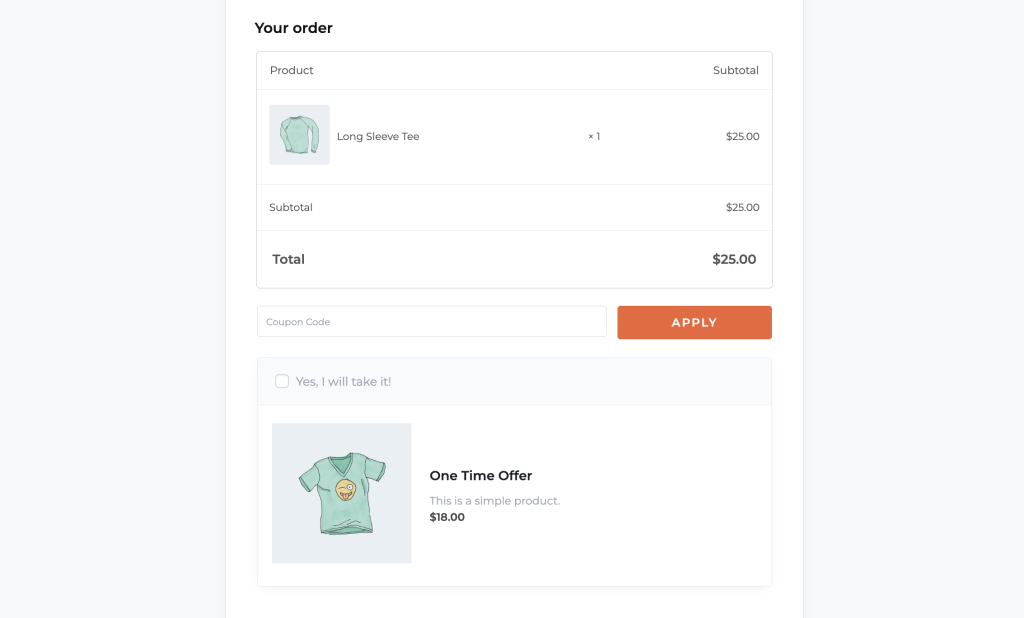
The order bump appears as a checkbox on your checkout page. It should be a small, complementary add-on priced at $5–$15. If your tripwire is a mini-course, the bump could be the worksheets. If it’s a template pack, the bump could be video walkthroughs showing how to use each template.
With CartFlows, you can add order bumps directly in the checkout settings: choose the product, write a short description, set the price, and it shows up as a one-click add-on on the checkout page.
On the Pro plan you don’t have to do the first two yourself. Order Bump AI suggests which product to offer, with a short reason for the pick, and a Write with AI button sits beside the checkbox label, headline and description fields.
If you run more than one tripwire, AI Auto mode is worth knowing about. You give it a pool of add-ons and each buyer sees whichever fits what’s in their cart, rather than the same bump appearing on every funnel.
The upsell is a one-time offer shown after checkout. This is typically your core product at a discounted price. If your flagship course is $197, offer it for $97 as a one-time post-purchase deal.
The critical detail: upsells should be one-click. The customer has already entered their payment info for your store. Asking them to re-enter it kills conversions. CartFlows handles this with one-click upsells. The customer clicks “yes” and the charge processes automatically using the card already on file.
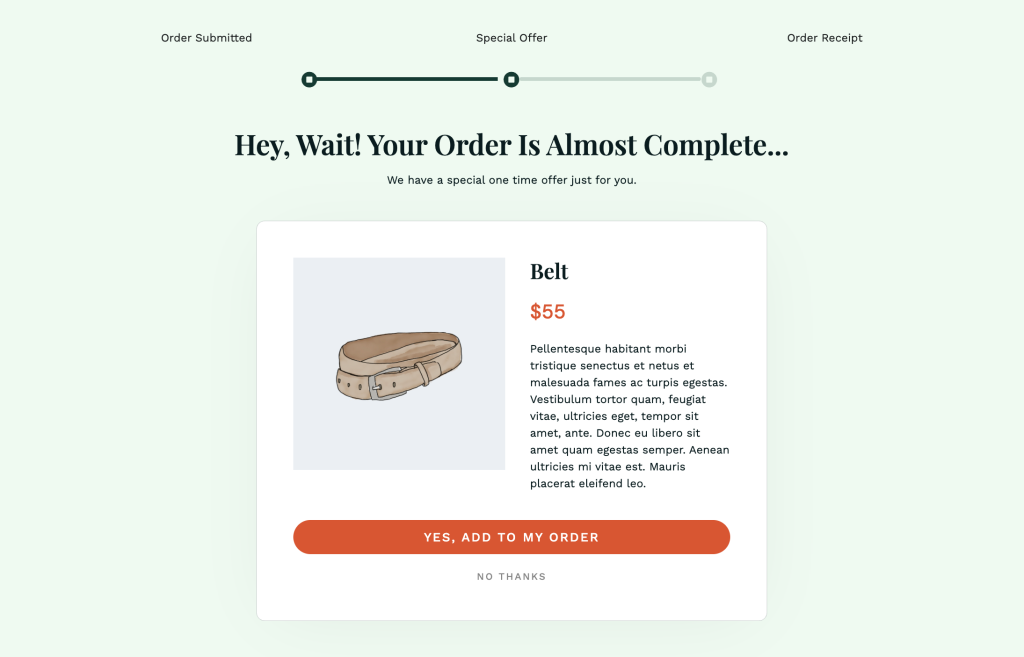
The downsell is your backup. If someone declines the upsell, show a lighter version at a lower price. Maybe the full course is too much, but a “quick start” module for $27 is just right.
Step 5: Set Up Email Follow-Up Sequences
Your funnel doesn’t end at the thank-you page. You need two email sequences:
For buyers: A post-purchase sequence that delivers the product, provides a quick win, builds the relationship, and eventually pitches your core offer. Keep it value-heavy. These people already trust you. Don’t waste it with aggressive selling.
For non-buyers: A sequence for people who opted in but didn’t buy the tripwire. They grabbed the lead magnet, so they’re interested. They just weren’t ready to buy in that moment. Nurture them with 3–5 emails that provide value related to the lead magnet topic, then re-present the tripwire offer.
Step 6: Drive Traffic and Optimize
A tripwire funnel without traffic is a page no one sees. Three channels to focus on:
Paid ads are the fastest lever. Facebook and Instagram ads targeted at your ideal customer, sending them to the opt-in page. Because your tripwire funnel generates revenue on the front end, you can often afford higher CPMs than competitors who are just collecting emails.
Organic content plays the long game. Blog posts, YouTube videos, and social media posts that attract your ideal customer and direct them to the lead magnet.
Your existing email list. If you have subscribers who’ve never bought, run them through the tripwire funnel. It’s the fastest way to identify your buyers.
Pro tip: Start with a small ad budget ($20–$50/day) and watch your numbers. Say your cost per lead is $3 and your tripwire converts 5% of leads at $17. That’s $0.85 revenue per lead from the tripwire alone. Now add an order bump converting at 35% ($9) and upsells at 15% ($47): your revenue per lead climbs to approximately $2.57. Not yet self-liquidating, but close. Bump that tripwire conversion to 10% (common once you’ve tested and optimized for a few weeks), and your EPL crosses $4.85, making you profitable from day one. The point: even modest conversion rates generate real revenue, and small optimizations compound fast.
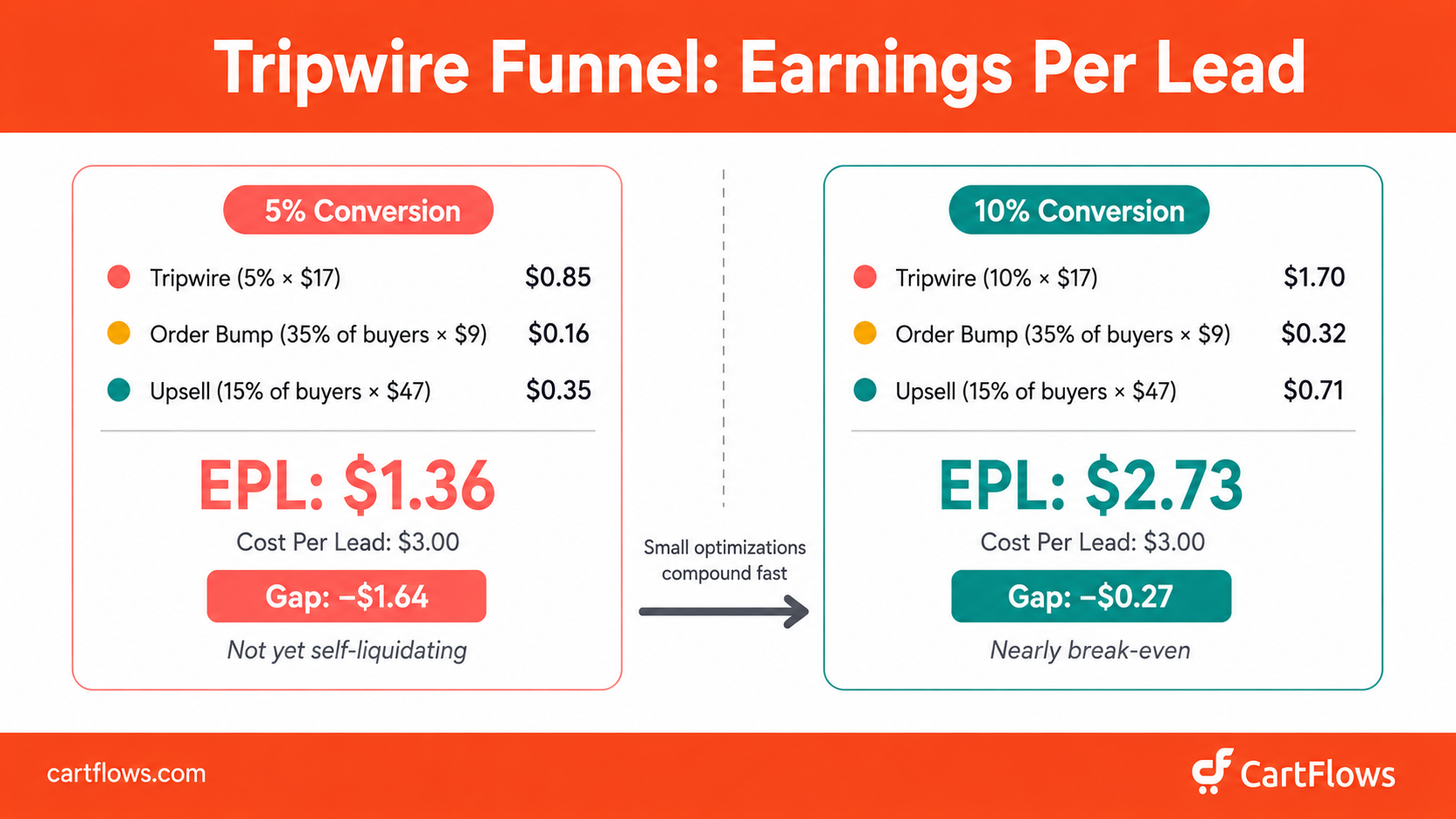
When we built the first tripwire template inside CartFlows, this was the exact math we optimized for: getting users to profitability before they’d spent more than a few hundred dollars on ads.
Further reading: How to Create a Sales Funnel in WordPress with CartFlows
Tripwire Funnel Metrics: What to Track
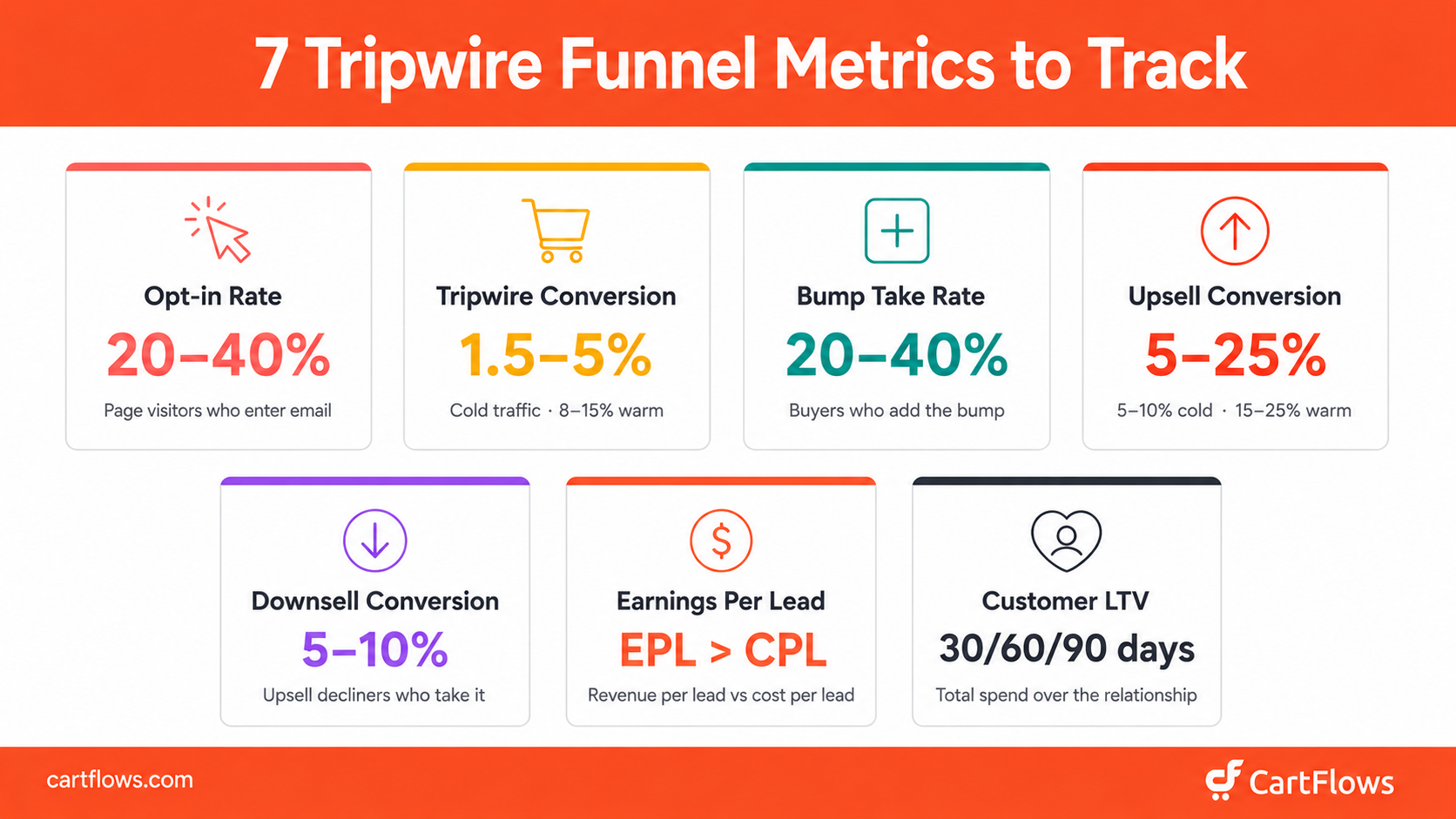
You can’t optimize what you don’t measure. Here are the numbers that tell you whether your tripwire funnel is working:
Opt-in rate: The percentage of page visitors who enter their email. Benchmark: 20–40% for a well-targeted audience with a compelling lead magnet. Below 15%? Your lead magnet or landing page needs work.
Tripwire conversion rate: The percentage of new subscribers who buy the tripwire offer. Benchmark: 1.5–5% from cold traffic is typical, with well-optimized funnels reaching 8–15% from warm audiences. This is the most important number in your funnel. If you’re consistently below 1%, your offer isn’t compelling enough, your price is too high, or your lead magnet isn’t aligned with the tripwire.
Order bump take rate: Percentage of tripwire buyers who add the bump. Benchmark: 20–40%, with 30%+ being a strong signal your bump offer is relevant. If it’s lower, test a different bump offer or rewrite the description. Both of those are things Pro can help with. AI can suggest a different product and rewrite the description, and split testing tells you whether the new version actually did better.
Upsell conversion rate: Percentage of buyers who accept the upsell. Benchmark: 5–10% for cold audiences, 15–25% for warm. Below 5%? Your upsell price might be too high, or the perceived gap between the tripwire and the upsell is too large.
Downsell conversion rate: Percentage of upsell decliners who take the downsell. Benchmark: 5–10%.
Earnings per lead (EPL): Your total front-end revenue divided by total leads. This is the number that tells you whether your funnel is self-liquidating. If your EPL exceeds your cost per lead, you’re acquiring customers for free.
Customer lifetime value (LTV): How much a tripwire buyer spends with you over their entire relationship. This is where the real ROI of a tripwire funnel shows up. Track it at 30, 60, and 90 days after the initial purchase.
In our experience with WooCommerce stores using CartFlows, stores with active tripwire funnels consistently see higher average order values and notably stronger email engagement from buyers compared to free subscribers. The gap is significant enough that even a modest tripwire conversion rate can meaningfully change your store’s unit economics.
The numbers don’t lie. Track them weekly, not monthly.
Common Tripwire Funnel Mistakes (and How to Avoid Them)
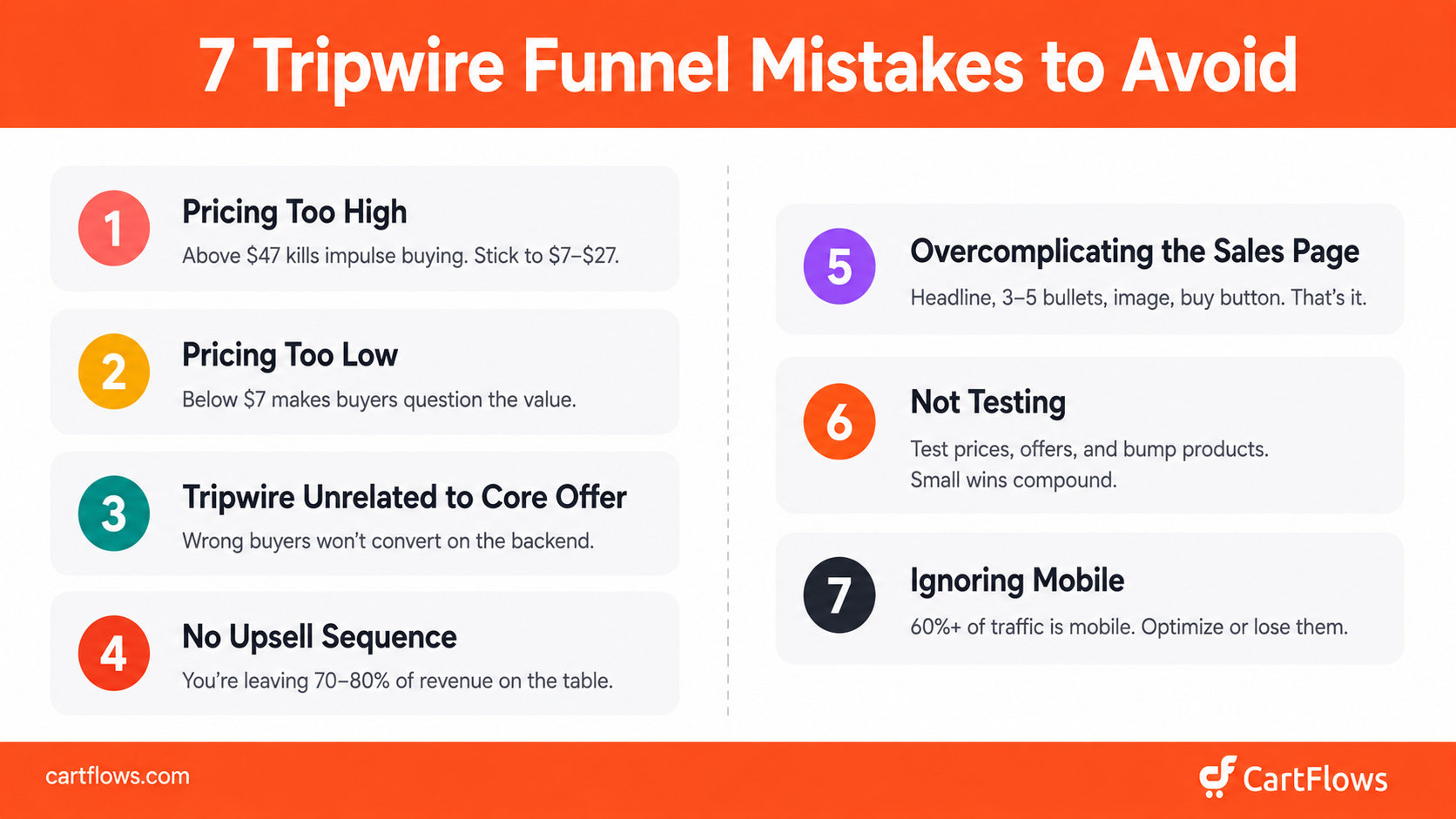
After analyzing dozens of tripwire funnels, these are the mistakes that kill conversions most often:
Pricing too high. If your tripwire is above $27, it’s no longer an impulse buy. It requires deliberation, and deliberation creates drop-off. Stick to $7–$27 unless your audience has a proven willingness to pay more.
Pricing too low. On the flip side, a $1 tripwire can actually devalue the offer. People associate price with quality. A $7 mini-course feels like a deal. A $1 mini-course feels suspicious.
Tripwire unrelated to the core offer. Your tripwire must logically lead to your main product. If the tripwire is about social media marketing but your store’s core offer is about WooCommerce checkout optimization, you’ve attracted the wrong buyers. They won’t convert on the backend.
No upsell sequence. A tripwire alone won’t make you money. The profit is in the upsell, the order bump, and the email sequence that follows. If you stop at the tripwire, you’re leaving 70–80% of your potential revenue on the table.
Overcomplicating the tripwire sales page. Your tripwire page doesn’t need a 3,000-word sales letter. It needs a compelling headline, 3–5 bullet points, a product image, and a buy button. You’re selling a $17 product to someone who just opted in. Keep it short and punchy.
Not testing. Your first tripwire offer, price point, and page design probably won’t be optimal. Test different prices ($7 vs $17 vs $27). Test different offers. Test different bump products. Small improvements at each stage compound into dramatically better results.
CartFlows Pro does this natively. Build variants of any step, including your tripwire page and your order bumps, run them side by side, and the dashboard shows which one earns more. Change one variable per test so the result means something.
Ignoring mobile. Over 60% of funnel traffic comes from mobile devices. If your store’s opt-in page, tripwire page, and checkout aren’t optimized for mobile, you’re losing the majority of potential buyers before they even see the offer.
Frequently Asked Questions
Final Thoughts
The tripwire funnel isn’t a hack. It’s a structural decision about how your store acquires customers.
Instead of hoping that free subscribers eventually buy something, you engineer the first purchase into the moment they’re most engaged, right after they opt in. The businesses that scale fastest aren’t the ones with the biggest email lists. They’re the ones that turn subscribers into buyers on day one, then compound that relationship over time.
Start simple. One lead magnet. One tripwire. One order bump. Get the flow working, then optimize from there.
Got questions about building your first tripwire funnel? Drop a comment below or reach out. We’ve helped thousands of WooCommerce stores set these up through CartFlows, and we’re happy to help you too.